Art Movements Explained
Art movements explained: a visual index from Renaissance to Op Art, with the clues that help you recognize each style.
When you meet an unfamiliar picture, a movement label can suggest a question you might otherwise miss. Is a stretched arm evidence of awkward drawing, or does every limb in the picture bend the same elegant way? Would a newspaper clipping have carried a joke for someone who knew the face printed on it? Art movements gather works around shared problems like these. The beginner's method for reading a painting starts with details you can point to before you reach for the label.
A pocket index for a first look
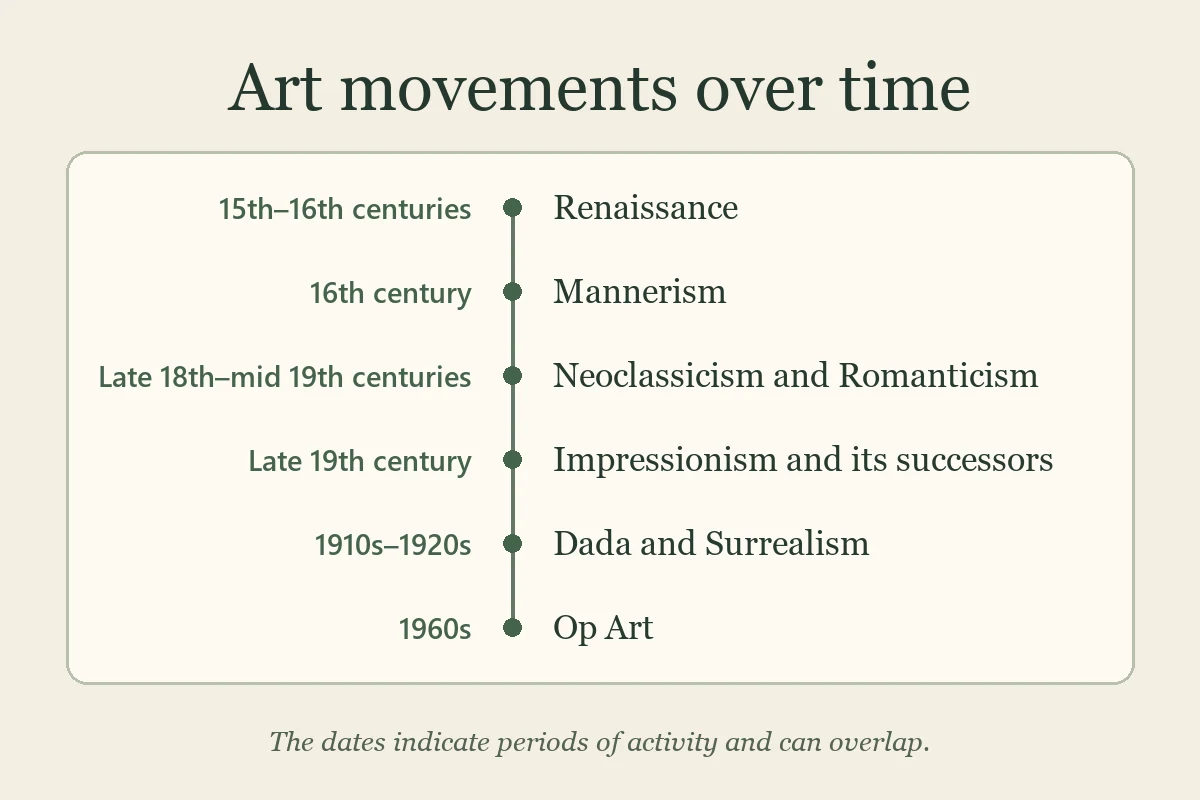
- Renaissance, fifteenth and sixteenth centuries. Follow the tiled floor or the series of arches toward a vanishing point. In northern European painting, a reflection in glass can reward an equally close look. Compare here · Renaissance paintings.
- Mannerism, sixteenth century. Trace an elongated body from shoulders to hips. Do the feet below it provide enough support for the pose? Compare here · Mannerism guide.
- Neoclassicism and Romanticism, later eighteenth to mid-nineteenth centuries. Where does a crowd direct your eye? David can bring outstretched arms together at a single point. A storm by Turner can make even the position of a vessel hard to fix. Compare here · Neoclassicism / Romanticism.
- Impressionism and its successors, later nineteenth century. Move back from an isolated dab of color. Does it become a patch of reflected light, the side of an apple, or a small part of a carefully ordered pattern? Compare here · Impressionism / Post-Impressionism.
- Dada and Surrealism, from the 1910s and 1920s. Start with an object's ordinary use. Its new title, material, size, or setting may explain why it has become strange. Compare here · Dada / Surrealism.
- Op Art, prominent in the 1960s. Pick one repeated unit and measure the gap to its neighbor. A small change in that interval can make the surface seem to move. Compare here · Op Art.
These dates mark overlapping European and transatlantic histories. They are starting points for this index, rather than a calendar every artist followed.
Renaissance, Mannerism, and the uses of order
In many Italian Renaissance paintings, carefully measured architecture gives figures a convincing setting. Masaccio could make a church wall appear to open into a chapel. Raphael could place philosophers within a sequence of arches and make an intellectual world seem spatially coherent. Northern European artists also investigated the visible world, sometimes through close attention to reflected light, textiles, glass, or polished metal. The guide to Renaissance paintings compares several such approaches without assuming one style for an entire continent.
Mannerism includes sixteenth-century artists who stretched inherited ideals of proportion and spatial clarity. An elongated neck, a figure seen in an intricate twist, or a room whose depths resist measurement can display an artist's ability to complicate an established convention. Compare a Renaissance grouping of people whose weight seems securely distributed with a grouping that turns bodies into an ascending spiral. The second arrangement can make a very different impression without abandoning technical skill or a classical subject.
Neoclassicism, Romanticism, and choices about history
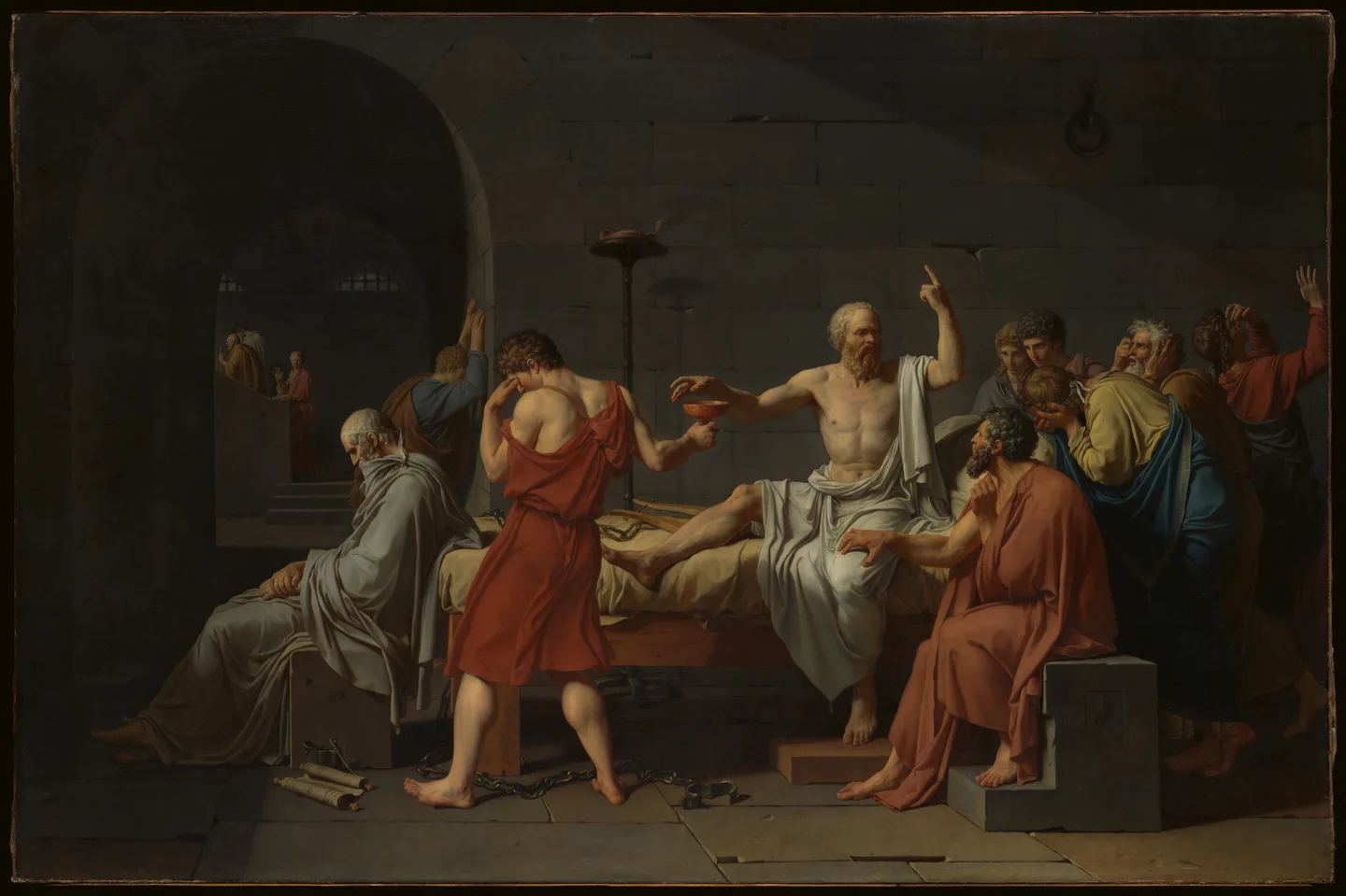
Neoclassical artists drew on ancient Greek and Roman models for subjects, forms, and arguments about civic life. In David's Oath of the Horatii, stone arches and carefully grouped bodies turn a pledge into something a viewer can read across a room. The directions of hands, swords, and limbs give a public action a memorable visual structure. Find the cup in another David canvas, The Death of Socrates. One hand offers it and another reaches for it. The gap between them gives the men a moment of choice. A classical costume by itself identifies neither an artist's politics nor the date a picture was made.
Romanticism developed amid overlapping interests in history, revolution, landscape, literature, and powerful emotion. A figure turned toward fog in Friedrich or a storm at sea in Turner can make the limits of human perception part of a painting's subject. The two movements overlap in time. The date on a label may establish that artists were contemporaries even when one painter's emphatic outlines and another's dissolving atmosphere produce very different encounters for the viewer.
Impressionists and their independent successors
The independent exhibitions that began in Paris in 1874 brought together artists with different techniques and interests. Alongside outdoor scenes and changing light were ballet rehearsals, domestic interiors, and modern leisure. The guide to Impressionism connects the varied works to the circumstances of their display. Monet's broken color and Degas's staged interiors can belong to the same historical discussion even when a surface-based checklist would sort them into different groups.
Post-Impressionism is a later umbrella term. Seurat's planned relationships of contrasting colors, Cézanne's investigation of volume, Van Gogh's directional strokes, and Gauguin's broad color areas offer quite different responses to preceding experiments. Look for the particular problem a work addresses. A tabletop that tilts toward the viewer poses a spatial question. A riverbank assembled from adjacent dabs of paint poses questions about how color combines at a distance. Neither question can be reduced to the dates in an introductory timeline.
Dada, Surrealism, and Op Art put the viewer to work
Dada artists made performances, collages, poems, and objects that questioned the authority of conventions during and after World War I. An ordinary manufactured object could acquire a different status through selection, a name, and an invitation to exhibit it. The Dada guide explains why a photographic record, a later replica, and a lost original can all enter the history of one work. Surrealists adopted some related techniques while developing distinct interests in dreams, desire, chance, and psychic associations.
Op Art directs attention toward the act of perception itself. Repeated lines or carefully spaced shapes can make a stationary surface appear unstable. Compare the experience with looking at storm clouds in a Romantic picture. One work represents movement in a depicted world. The other may produce an experience of movement without depicting a moving object. The art history topic supplies more detailed studies of individual movements.
Frequently asked questions
Can the same artist belong to more than one movement?
Yes. Careers extend across changing groups, cities, and commitments. A painter might exhibit with a group for several years while later pursuing different questions. Use the particular work's date and exhibition history when applying a label.
How is movement in art different from an art movement?
Movement within an image describes an effect, such as the path of an eye along a diagonal or the impression of a running body. An art movement names a historical grouping or shared practice. A picture can show energetic movement while belonging to any number of historical traditions.
Try a label on two paintings
Compare the space under the brothers in David’s oath with the ground under Liberty’s feet in Delacroix. Which lines steady the figures, and where does the ground interrupt their advance?