Op Art Movement
Op Art movement: optical illusions, pattern, and motion—how to recognize Op Art and why it tricks the eye.
The Op Art movement gives your eyes a problem that remains active after you understand how the picture was made. Straight lines appear to buckle, two flat areas seem to occupy different depths, or a perfectly stationary pattern seems to pulse. The guide to art movements places these works among twentieth-century experiments in perception. Begin with a distinction you can test. Describe the actual printed or painted elements, then describe the experienced motion. The two descriptions can be true at the same time.
A grid appears to fold without a drawn crease
In Bridget Riley's Movement in Squares, a pattern of black and white quadrilaterals contracts into increasingly narrow intervals. At one place the squares become thin slivers. The support remains flat, yet many viewers experience a fold or turn. Trace one horizontal boundary and then another. Their relative stability helps explain why compressed vertical intervals feel like a change in the surface itself. A viewer supplies depth from variations that can be described entirely in two dimensions.
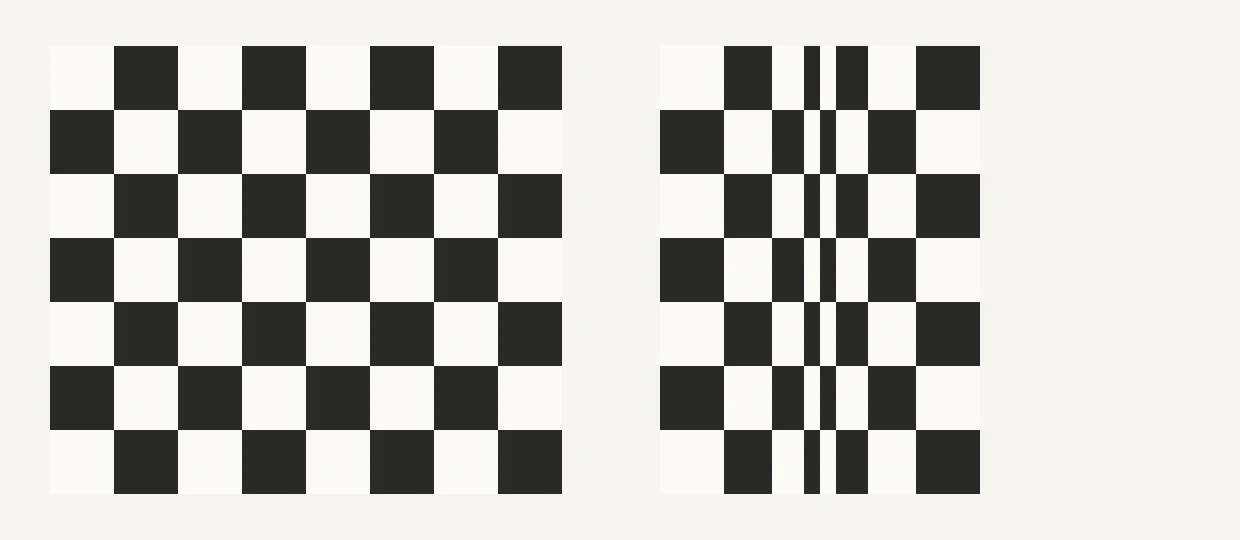
Compare the two checkerboards in the original teaching diagram. In the regular grid, each column is as wide as its neighbors. In the second, the same number of rows continues across a band of narrow cells. Follow a horizontal edge from one side to the other. Where does the surface seem to turn? The diagram isolates a change in spacing. Riley’s painting has its own pattern of intervals.
Try the spacing experiment on squared paper. Outline eight neighboring columns, making them four, three, two, one, one, two, three, and four squares wide. Keep the height of every row at four squares. Color alternate cells black, switching the first color at the beginning of each row. Lay a straightedge along a horizontal boundary. It stays straight even where the black and white units look squeezed together. Now cover the four middle columns. Compare what you can still see of the ordinary checkerboard with the impression you had of a fold. This is a small experiment with one variable, rather than a copy of Riley's painting.
Vasarely makes a flat field appear to bulge
In works from Victor Vasarely's Vega series, a repeated grid expands or bends around a central swelling form. A shape that begins as a small, regular unit near the edge may grow, stretch, or curve as it approaches the center. Color relationships can reinforce that shift. Cover the area of strongest enlargement and consider how many central marks would be needed to suggest a sphere on their own. Much of the effect derives from change across a sequence.
Dürer's earlier woodcut The Rhinoceros supplies a different use of repetition. Follow the dark hatching around the animal's front leg. The lines bend around a volume you have already recognized from the joint, the hoof and the outline of the belly. In a Vega grid, changing intervals can suggest a swelling surface before you have a name for any object on it. If you hide the rhinoceros's hatching, a leg is still there in outline. If you make every interval of a Vega grid identical, you remove much of the evidence for the swelling. The useful comparison is what each set of marks contributes.
Color changes when its neighbors change
Two pieces cut from the same painted sheet can appear different when placed on different colored grounds. The physical paint remains the same while the perceived relation shifts. This phenomenon, often discussed through simultaneous contrast, mattered to many artists who investigated color, including Josef Albers in Interaction of Color. His work supplies a productive comparison with Op Art, even when discussing artists whose affiliations and methods differ. Observe a boundary where two strongly contrasting values meet and compare it with a boundary between closer values.
When fine stripes or dots are reproduced digitally, the screen and resizing process can introduce additional patterns. A moiré pattern in a thumbnail can be an artifact of sampling rather than part of the original work. Inspect a reliable full image and a detail at different sizes. If a claimed effect disappears or reverses when the file size changes, qualify your account of the physical object. The abstract paintings guide includes other works whose scale changes the viewing experience significantly.
A movement comes into view through an exhibition
The Responsive Eye, held at New York's Museum of Modern Art in 1965, publicized work that made perception itself a subject. The Thyssen museum’s account of Vasarely’s Fény describes his participation and shows a later canvas. Follow the grid from its border to the surface that appears to swell at the center. The exhibition brought a range of approaches to a broad audience. Op Art designs also circulated through fashion, magazines, and advertising. A motif enlarged across a museum wall and the same motif printed on moving fabric encounter different supports, scales, and conditions of use. Ask which part of a response comes from the image and which comes from the movement of its setting.
Compare Op Art with Surrealism, where a painting may disturb ordinary expectations through the behavior of represented objects. Tate’s account of Op Art places both Vasarely and Riley among the artists investigating these effects. The art history topic includes further movements that enlist the viewer in very different kinds of work. Consider the replica exhibited as Duchamp’s Fountain. There the setting can alter the status of the object even when your eyes register the same shape.
Frequently asked questions
Do I have to stare until I see motion?
A brief look at a detail and a return to the whole are sufficient for describing the underlying arrangement. Responses vary among viewers and displays. If a pattern is uncomfortable, look away and use a smaller, static reproduction or a verbal account of its structure.
How does Op Art differ from kinetic art?
Kinetic art can involve components that actually move through motors, air, touch, or changing physical arrangements. An Op Art painting can create an impression of motion on a stationary surface. Particular exhibitions and artists brought the two concerns into conversation, so check what physically moves in the work you are studying.
Test the fold with a straightedge
Cover the narrowest columns in the teaching diagram. Does the impression of a fold survive? Uncover them and lay a straightedge along a row to check which boundary stays level.