Mannerism Art Movement
Mannerism art movement: elongation, odd color, and artificial poses—how to recognize Mannerist painting.
The Mannerism art movement took shape in sixteenth-century Europe as artists developed elaborate responses to the celebrated achievements of earlier Renaissance art. A familiar body could become extraordinarily long, a room unexpectedly shallow, or a hand more intricate than the task it performs seems to require. The art movements guide places these decisions within a larger history of artistic training and invention. Start with one awkward-looking relationship and ask what the painting gains by making a viewer work to understand it.
Parmigianino makes a body exceed its setting
In Madonna with the Long Neck, the Virgin supports an unusually extended Christ child across her lap. Her own neck, fingers, and upper body stretch into an elegant, continuous arrangement. A group of angels presses closely against one side, while an apparently distant small figure occupies another part of the scene. Try locating the ground under everyone present. The bodies have a remarkable physical presence even where the space that should support them proves hard to map.
Compare the long column at the right with the Virgin's neck. Both rise from broad forms into a narrow, sustained vertical, but the column belongs to a setting whose scale is difficult to fix. The small figure with a scroll nearby makes the change in scale even more abrupt. Parmigianino left the picture unfinished at his death. That helps explain the unresolved setting, while the parallel between column and neck gives you a visual rhyme that survives even in the unfinished picture. In the guide to Renaissance paintings, watch for a column that helps measure the room a figure inhabits. Then return to this one and see how unhelpful it is as a ruler.
Pontormo removes the ground you expect to find
Pontormo's Capponi Chapel altarpiece in Florence, often called the Deposition, gathers a cluster of figures in bright, unusual colors. Christ's body is carried among them, and several people turn toward the viewer. Locate the feet of those bearing weight and compare their positions with the width and direction of the body above them. A person can look poised on the lightest touch of a toe while participating in an action that ought to require substantial force.
The setting supplies relatively few of the architectural or landscape cues that might anchor such a group. Across the surface, separate patches of pink, blue, and green form a chain of bodily turns. Cover one bright area and see which adjacent figure becomes harder to connect to the whole. Color can hold together an arrangement whose physical mechanics remain uncertain. From the original chapel, framed by actual architecture, the viewer encounters the altarpiece within a more defined space than the painted figures themselves appear to enjoy. For another unstable grouping, examine the bodies in Géricault’s Raft of the Medusa. There the tilt of the raft gives the figures a physical reason to cling to one another.
Bronzino turns elegance into an interpretive problem
In Bronzino's An Allegory with Venus and Cupid, the smooth pale bodies of the central pair stand out against a blue cloth. Look down to the masks lying on the ground, then up to the older figure reaching across the top with an hourglass above his shoulder. An hourglass gives you a reason to associate that figure with Time. A mask suggests concealment, but it has fallen loose from any particular face. The painting offers different degrees of certainty about its own clues. Try to explain the central embrace once with the blue cloth in view and once with that upper action covered.
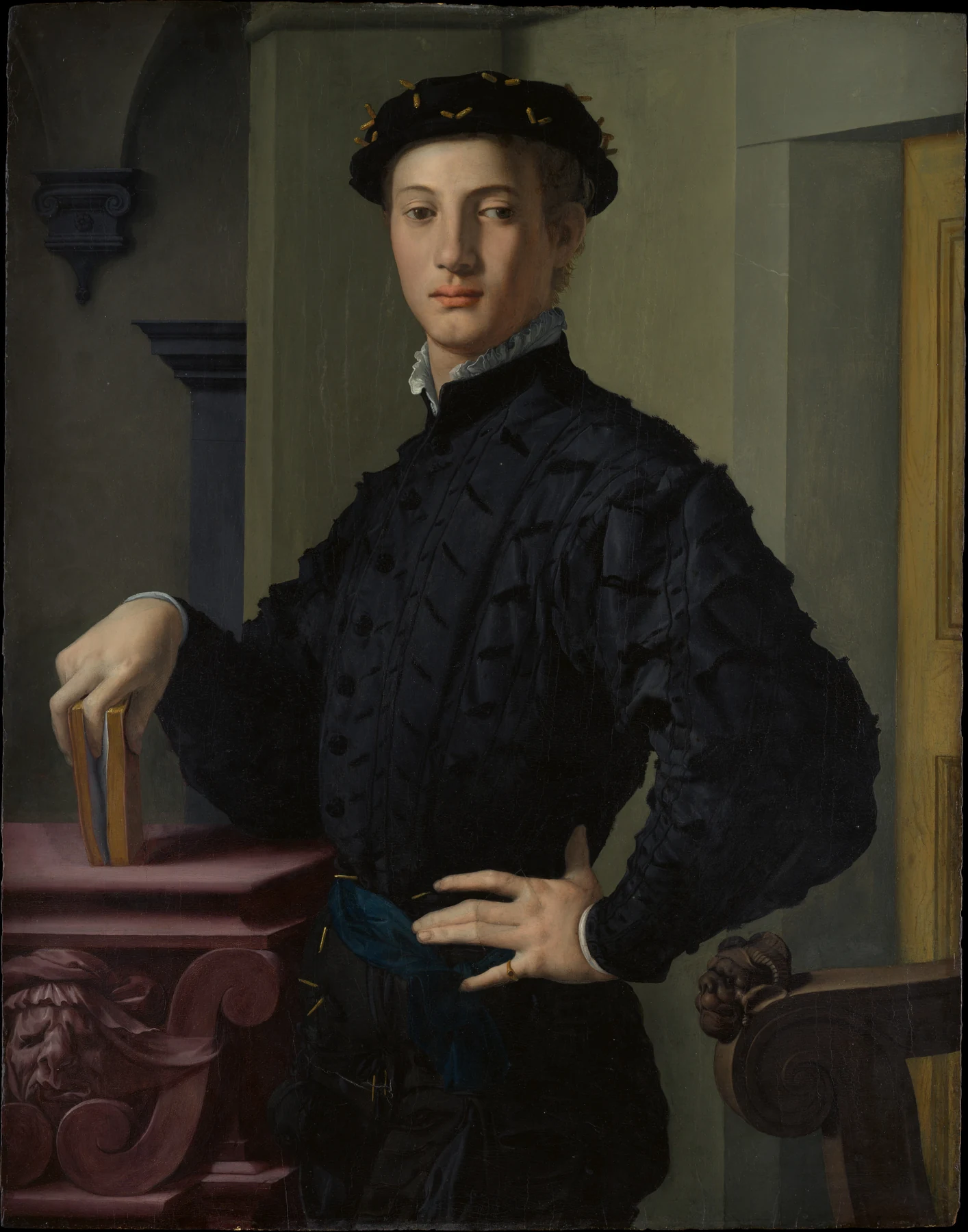
Compare the fingers of the embracing figures with the hand resting on a book in Bronzino’s Portrait of a Young Man. In the portrait, you can trace the hand back to one sitter. In the allegory, following a hand back to its owner can change how you read the embrace.
Courtly audiences could value learned references, wit, elaborate finish, and displays of skill. These conditions can help explain why a picture sustains several layers of interpretation. They do not establish that a viewer today must recover a perfectly fixed solution for every detail. Compare the polished transitions from light to shadow on one limb with the sudden jump in direction where that limb meets another body. The surface can establish formal continuity and narrative confusion at the same time.
Distinguish a deliberate twist from a general distortion
A twisting figure can turn shoulders, hips, and head in different directions, inviting the viewer to reconstruct a body in motion or to imagine turning around it. Such poses occur in sculpture and in painting. They need a specific comparison before they become evidence for Mannerism. The Neoclassical movement guide considers other artists with a strong interest in antique bodies, polished contours, and studied gestures. A smoothly modeled limb alone cannot decide between the two histories.
El Greco's View of Toledo, gives you a way to ask the same question of a landscape. Trace the city's pale buildings against the stormy sky. A tower can be easy to locate even while the green hillside seems to tip or surge beneath it. Then examine Velázquez's Juan de Pareja. The lit edge of the collar comes forward against the dark coat without upsetting the space around the sitter. The art history collection gives their broader context. Two paintings made in Spain can organize space quite differently within little more than half a century.
Frequently asked questions
Does mannered mean that a Mannerist painting is badly drawn?
The everyday adjective can suggest pretension, while the historical term concerns particular ideas of style, skill, and invention. An artist who deliberately elongates a neck or twists a body may be demonstrating control of a convention. Examine a repeated decision across figures or works before assigning it to accident.
Is Mannerism restricted to Italy?
Italian courts and workshops were crucial, but artists traveled and prints circulated. Related practices developed at courts and in workshops elsewhere in Europe. Museum labels may use terms such as Northern Mannerism for particular networks. Identify a work's place, patronage, and date along with the visible characteristics you associate with the label.
Look for a second instance
Choose one bent wrist or elongated limb in Bronzino or Parmigianino. Find a second figure with a similar turn. What does the repetition do for the composition?