Neoclassical Art Movement
Neoclassical art movement: order, symmetry, and classical subjects—how to tell Neoclassical painting from Baroque.
The Neoclassical art movement gave ancient subjects, carefully studied bodies, and architectural order a new place in eighteenth- and early nineteenth-century European culture. A figure in a toga can belong to many centuries, so start with the way the picture organizes a decision, a public action, or a model of conduct. The art movements overview places Neoclassicism beside contemporary alternatives. A particularly revealing exercise is to trace where the eyes, hands, and objects all meet in a scene of civic obligation.
Read the oath from the swords outward
In Jacques-Louis David's Oath of the Horatii, three brothers extend their arms toward the swords held by their father. Three arches divide the painted background. At the right, seated women and children form a group shaped by bending bodies and downcast heads. The joins in the pavement and the sharply described architecture give the action a stage that a viewer can grasp quickly. Locate the father's hand and follow the lines away from it. Duty becomes a physical arrangement of limbs, objects, and gazes.
The subject comes from a story of early Rome in which familial bonds cross a political division. David painted the work in the 1780s under a royal commission. Its later resonance with revolutionary audiences is important, but it would be a mistake to describe its origin as a commission by the French Republic. Separate the moment of production from later readings. The guide to reading a painting suggests how to hold a piece of contextual evidence next to a specific visible decision.
Archaeology and travel supplied more than costumes
The excavation of sites including Herculaneum and Pompeii made ancient objects and interiors newly available for study and reproduction. Drawings, prints, casts, and published accounts could travel to artists who never visited the sites themselves. Academies taught students to study antique sculpture and the human figure. A painting's classical references can therefore involve posture, framing, surface, and ideals of beauty as well as a recognizable helmet or an episode taken from ancient history.
Angelica Kauffman's Cornelia Presenting Her Children as Her Treasures offers another point of entry. A woman displaying jewelry prompts Cornelia to indicate her children. Gesture converts an exchange among women into an example of virtue drawn from Roman history. Compare the values attached to the bodies with those attached to objects held out for display. The painter's reputation as a history painter also opens questions about who could receive academic training, compete for commissions, and claim authority over elevated historical subjects. Compare this borrowing from antiquity with the medieval models used by Arts and Crafts book designers. Which historical choices could a reader feel by handling the finished object?
Examine the edge of a body
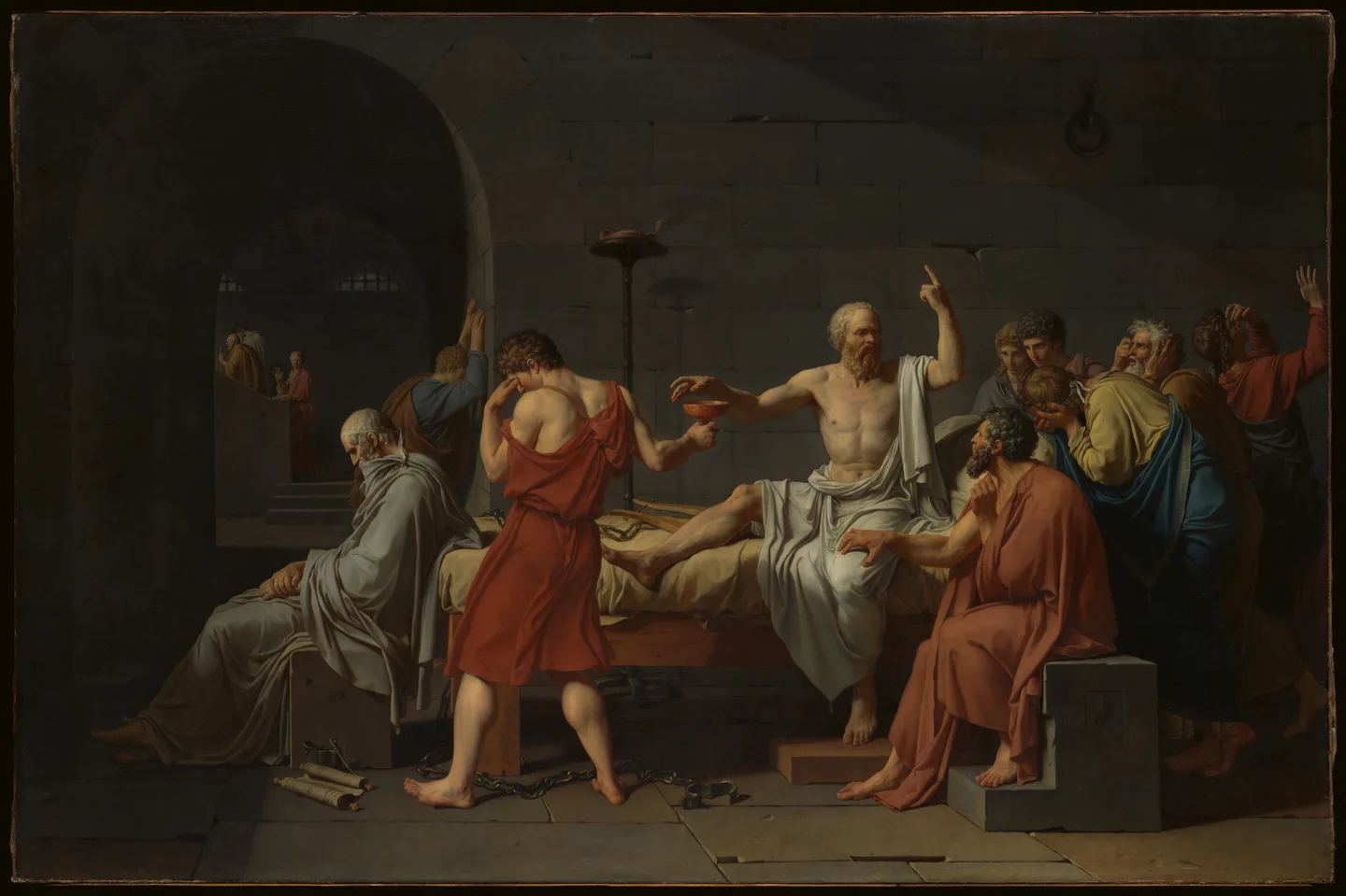
In David's The Death of Socrates, look at the narrow gap between the cup and the philosopher's reaching hand. Socrates points upward with his other hand. The young man holding out the poison turns his head away and covers his face. Imagine moving the cup a hand's breadth to the right until it touches Socrates' fingers. You would change the time of the whole painting. David has chosen the instant when Socrates can still speak and the attendant must wait for him to finish.
At the foot of the bed an older man in pale clothing sits with his back to the exchange. He is Plato, whose Phaedo supplies the account of Socrates' death. In that account, Plato was absent through illness. David also paints him older than he would have been at the time. His presence gives the viewer two ways into the room, through the instant at the cup and through the author who preserved the story. Compare Rubens's Descent from the Cross in Antwerp. There the painted weight travels along a white shroud through the hands of several helpers. Take one helper's hand out and the task becomes harder to imagine. Take Plato out of David's picture and the men could still perform every action, but the link to the written account would disappear.
Compare it with Romantic history painting
Early nineteenth-century painters continued to represent public events, moral choices, and historical suffering. In Delacroix's Liberty Leading the People, a flag and an advancing group give the viewer a substantially different relation to a public action. The Romanticism guide examines what happens when bodies seem to cross unstable ground toward a viewer instead of performing in a clearly bounded architectural space. The academy, politics, and patronage remained important across these changing approaches.
Distinguish the year an artist painted a scene from the period shown in it. David exhibited Socrates at the Salon in 1787. Its setting takes us to Athens in 399 BCE. David’s double portrait of the Lavoisiers belongs to the following year and shows two of David's contemporaries beside a red desk and scientific glassware. The painter did not need an ancient costume to make a hand on a shoulder register from across a room. The art history guides give you more ways to compare what artists borrow from antiquity with what they observe in their own time.
Frequently asked questions
Is Neoclassical painting always symmetrical?
Many examples use balanced arrangements, but a work can organize a centered moral action through striking asymmetry. The two groups to either side of the father in Oath of the Horatii embody very different postures and responses. Look for order in the relation between groups as well as in an exact mirror image.
How can I tell ancient art from a Neoclassical revival?
Check the object's date, medium, maker, collection history, and original setting. Ancient Roman dress or architecture can be represented by a much later painter. A museum label describing an oil painting commissioned for an eighteenth-century exhibition establishes a very different context from the label of an excavated ancient wall painting.
Draw the ground under two decisions
Sketch the pavement beneath the father in Oath of the Horatii and the barricade beneath Liberty. How does each surface change the direction in which the figures can move?