Arts and Crafts Movement
Arts and Crafts movement: handmade objects, natural motifs, and a reaction to industry—how to recognize it.
The Arts and Crafts movement asks what kind of life is built into an ordinary chair, a length of wallpaper, or a printed book. Who designed the object, who made it, and what can you discover about that labor by looking at the finished surface? The guide to art movements distinguishes organized exhibitions and workshops from labels for visual resemblance. Arts and Crafts offers an especially clear case in which the conditions of making matter as much as an object's recognizable flowers, oak surfaces, or visible joints.
A chair reveals decisions a painting can hide
Look at a Sussex armchair from Morris & Co. The dark wooden frame gives a clear silhouette against a wall. The rush seat fills the rectangle between the rails, with diagonal seams running in from its corners. Follow one arm backwards to the upright that supports it. Then follow a horizontal rail down near the feet and see which two legs it braces. Even a small photograph shows which elements carry the sitter's weight and which hold the frame steady. A label telling you that the seat is rush answers another question that a photograph alone may leave open.
This approach developed partly in response to industrial production and the division of labor. In nineteenth-century Britain, John Ruskin and William Morris wrote about the relation between workmanship and the worker's life. Their arguments went beyond a preference for rough surfaces. A carefully finished object might still reflect an effort to reunite designing and making. Conversely, an industrial product can imitate a visible joint or a hammered texture. Before identifying production methods, check the workshop history and medium line alongside your observations. Look at the Roman furnishings in a Neoclassical history painting. What could a joiner learn about a piece of furniture from its silhouette, and what would require seeing its underside?
Find the repeat in a length of printed cotton
In Morris's Strawberry Thief, thrushes raid strawberries among twisting leaves. To find the repeat, choose a bird facing left and mark where its beak meets a berry. Travel horizontally until you find a second bird with precisely the same berry in precisely that position. The nearest bird may be facing the opposite way. That gives you a reflected neighbor, while the matching beak and berry give you a whole repeat. Now imagine a printer shifting the next block by the width of a beak. The stems that should join across the boundary tell you where an error in registration would show.
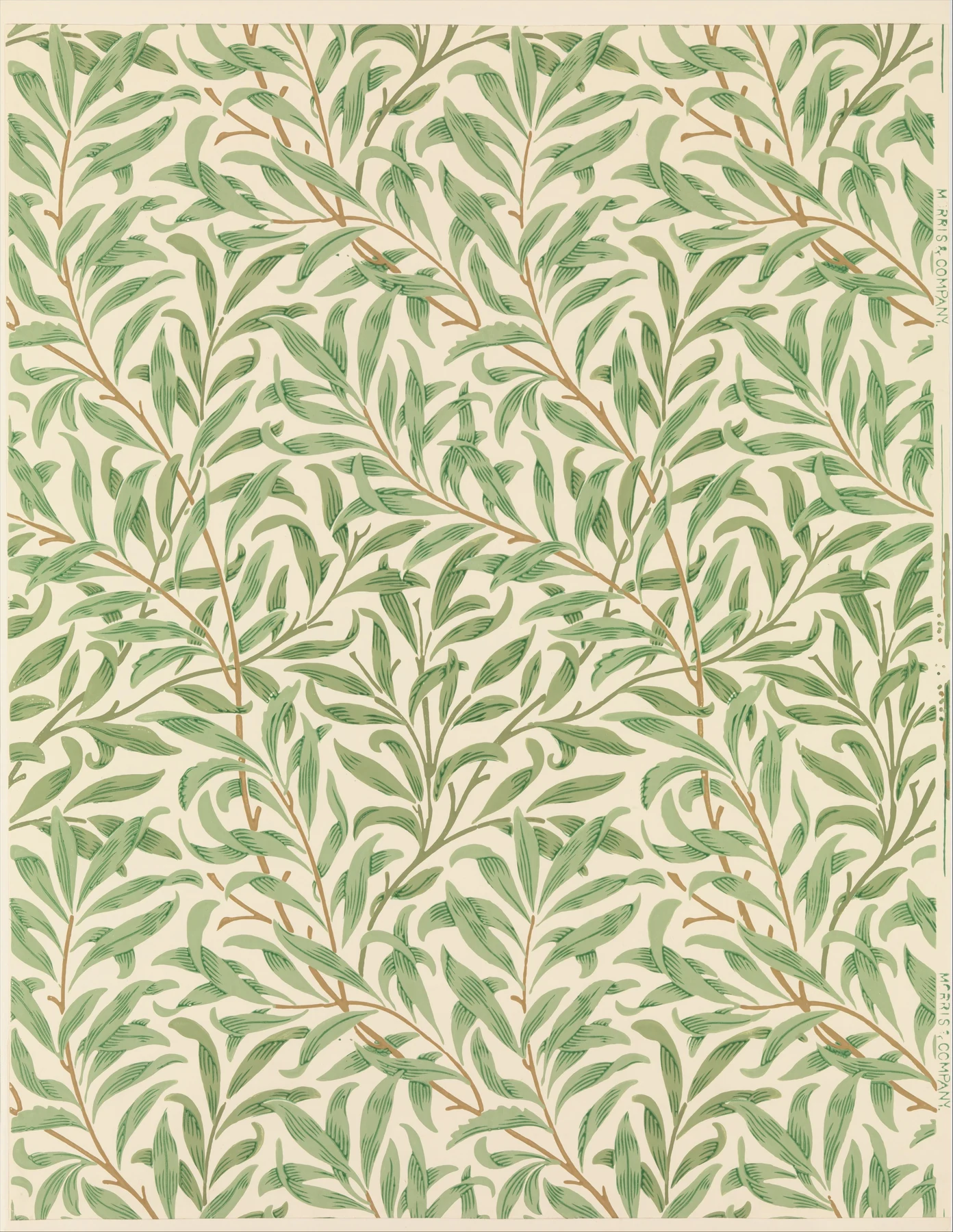
The illustration shows a different Morris design, Willow Bough, printed on wallpaper. Pick a fork in one stem and find the next place where it branches at exactly the same angle. The fork plays the same role as the thrush’s beak in finding the repeat. The Met’s medium line identifies the paper support.
The original Strawberry Thief design was printed on cotton. In the indigo discharge process described by the V&A, the dyer first gives the cloth a blue ground and removes color in selected areas. A pale leaf can therefore mark a place where a process took color away. Morris's printers built the polychrome pattern through successive operations. A photograph of the design printed on modern paper can reproduce every thrush and still tell you little about those operations. Turn to the guide to flower painting. A flower leaning out of a painted vase can end wherever the painter chooses. A branch in a textile repeat has to meet its continuation on the next stretch of cloth.
Rooms and books put several crafts in conversation
The Red House, designed by Philip Webb for Morris and his family, brought architecture, furnishings, decoration, and collaboration into close relation. A window changes how a textile receives light. A bench can answer the scale of a wall. Look at an interior photograph and choose two objects that share a color, motif, material, or practical function. Then ask whether the relationship belongs to the original arrangement or to a later restoration or display.
Morris's Kelmscott Press approached the printed page as a similarly coordinated environment. Type, margins, initials, illustrations, and bindings could be designed to work together. In the Kelmscott Chaucer, illustrations by Edward Burne-Jones sit within an elaborate printed architecture. Before reading a line, compare the width of the text block with the ornament that frames it. The Pre-Raphaelite guide gives context for collaborations among artists and designers who shared an interest in medieval literature, surface detail, and the processes of making things.
Follow an ideal through its practical tensions
Time-consuming skilled labor could make Arts and Crafts objects expensive. A movement concerned with the quality of everyday life thus faced questions about who could afford its products. Different workshops related to machinery and commercial distribution in different ways. An American factory-made chair influenced by Arts and Crafts ideas, a British handprinted book, and a locally organized workshop may share values or shapes without sharing the same production arrangements.
A botanical motif, visible joinery, and a documented cooperative workshop represent three different criteria. With a real object in front of you, test the motif against the date, maker, material, and production evidence. The art history topic offers other movements where an object belongs by its history of making or use as much as by its surface appearance.
Frequently asked questions
Did Arts and Crafts designers reject all machines?
Their positions varied. Many criticized industrial systems that split conception from skill or produced poorly made objects. Particular makers could still use tools, machinery, or commercial workshops. Check the actual manufacture of an object before drawing a conclusion from its handmade appearance.
Is every piece of furniture with exposed wood an Arts and Crafts work?
Visible wood is widely used across time and place. Look for a combination of date, workshop, construction, design intentions, and connection with the movement's networks. A label identifying a later revival or a design influenced by Arts and Crafts makes a different historical claim from one identifying an original period object.
Find the repeat on two surfaces
Mark one stem fork on the wallpaper and one beak beside a berry on the cotton. Find each motif’s next exact match. Which clues identify the repeat, and which require the maker’s record to explain?