Famous Flower Paintings (and What to Notice)
Famous flower paintings: from Dutch still lifes to Van Gogh's sunflowers, and the details that reward close looking.
Famous flower paintings offer a surprisingly demanding exercise in identification. A bouquet can unite plants that bloom months apart, and a petal seen from behind can look unlike every other flower in the vase. The guide to famous paintings asks how a detail relates to the whole composition. With flowers, begin by following a single stem from its head toward its base. Ask whether the arrangement could stand, how the light enters it, and which blossoms are already beginning to fade.
A bouquet can bring several seasons together
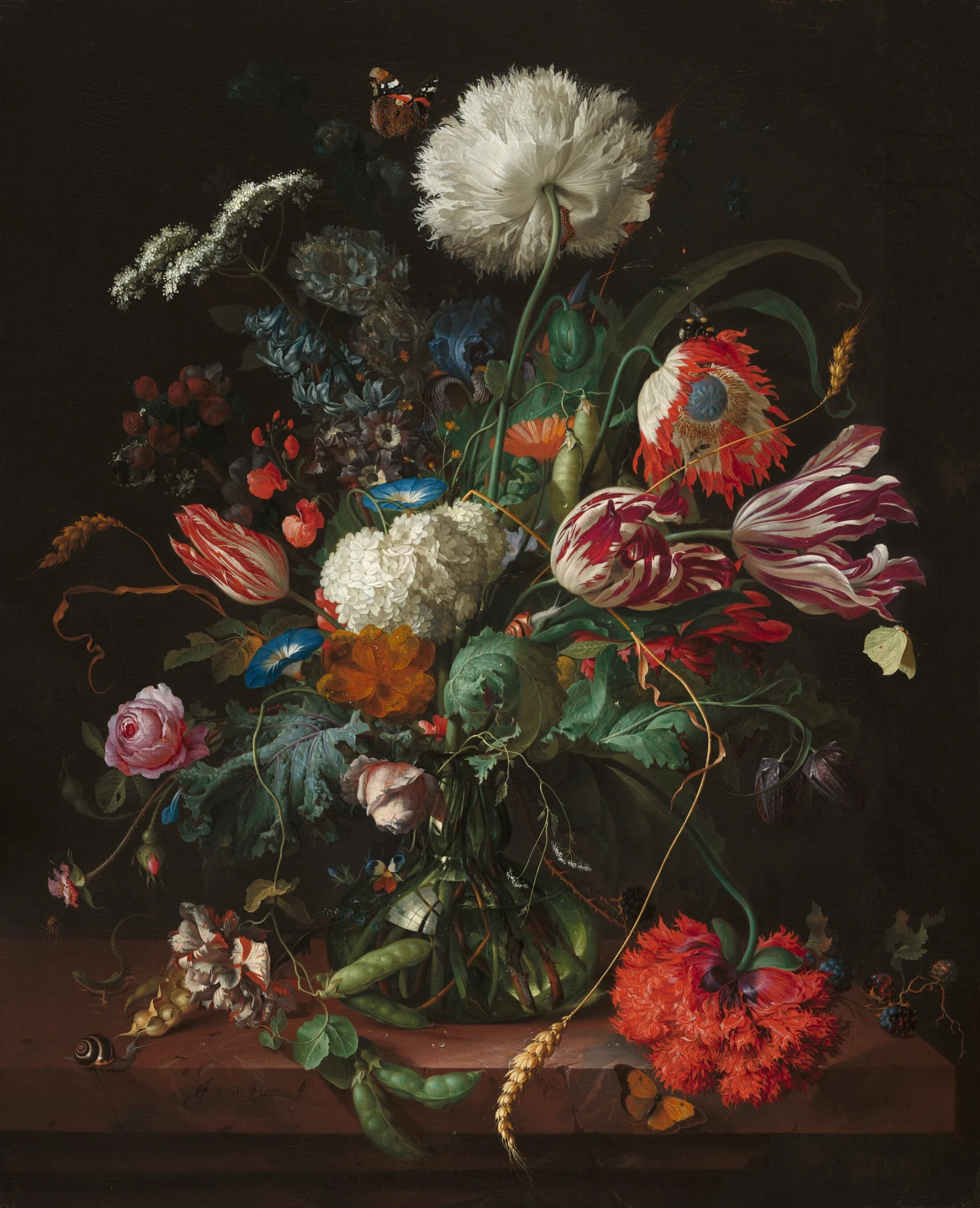
In seventeenth-century Dutch flower painting, a carefully arranged bouquet can unite blooms with different flowering times. A painter might prepare studies of specimens individually, then combine them on a single panel or canvas. This helps explain the extraordinary freedom of certain arrangements. The largest blossoms face outward at just the angle needed to display their distinctive markings. A heavy flower may rise far above the apparent neck of its vase without the crowd below seeming to displace it.
Open Rachel Ruysch’s Flowers in a Vase at the National Gallery in London. A flower may emerge into bright light while its supporting stem disappears into deep shade. A drooping petal or a gap in the outline lets air into a mass of complicated forms. Begin with the outer silhouette and mark three places where something projects beyond the main cluster. Those extensions can lead you to an insect, fine blade of grass, or curling tendril whose scale makes the central blooms appear especially large and substantial.
Ask what the vase, shelf, and insects contribute
In Jan Davidsz. de Heem’s Vase of Flowers in Washington, start with the insects among the blooms and the ledge beneath the vessel. A ledge gives weight to the display and offers a place where a petal might fall. The reflective surface of a vessel may record a window or direction of illumination. Before interpreting an insect as a symbol, describe its position. A butterfly silhouetted against a pale blossom performs a very different compositional job from an insect nearly invisible in a patch of shadow.
Some flower pictures have been interpreted through ideas about transience, collecting, luxury, scientific observation, and trade. Each reading calls for specific evidence. A drooping stem may support attention to time. An imported variety or valuable specimen requires botanical or historical identification. A museum's description can help distinguish those claims. Keep three separate notes for one flower. Record the striped petal you can see, the species the museum identifies, and any proposed meaning for which the catalogue supplies a period source. If only the first entry is certain, leave the other two open. In Find It in the Painting practice locating a target by describing the object beside it and checking the relative sizes of two neighboring forms.
Van Gogh gives one kind of flower many states
In the Arles Sunflowers, Van Gogh assembled large yellow blooms in a vase against a predominantly yellow setting in some versions. Look for broad disks, shaggy petals, spiky heads, and heads that tilt forward. The recognizable identity of a sunflower survives substantial changes in age and orientation. Instead of counting flowers first, divide them by pose. Which face you, which show their sides, and which appear to have lost much of their ring of petals?
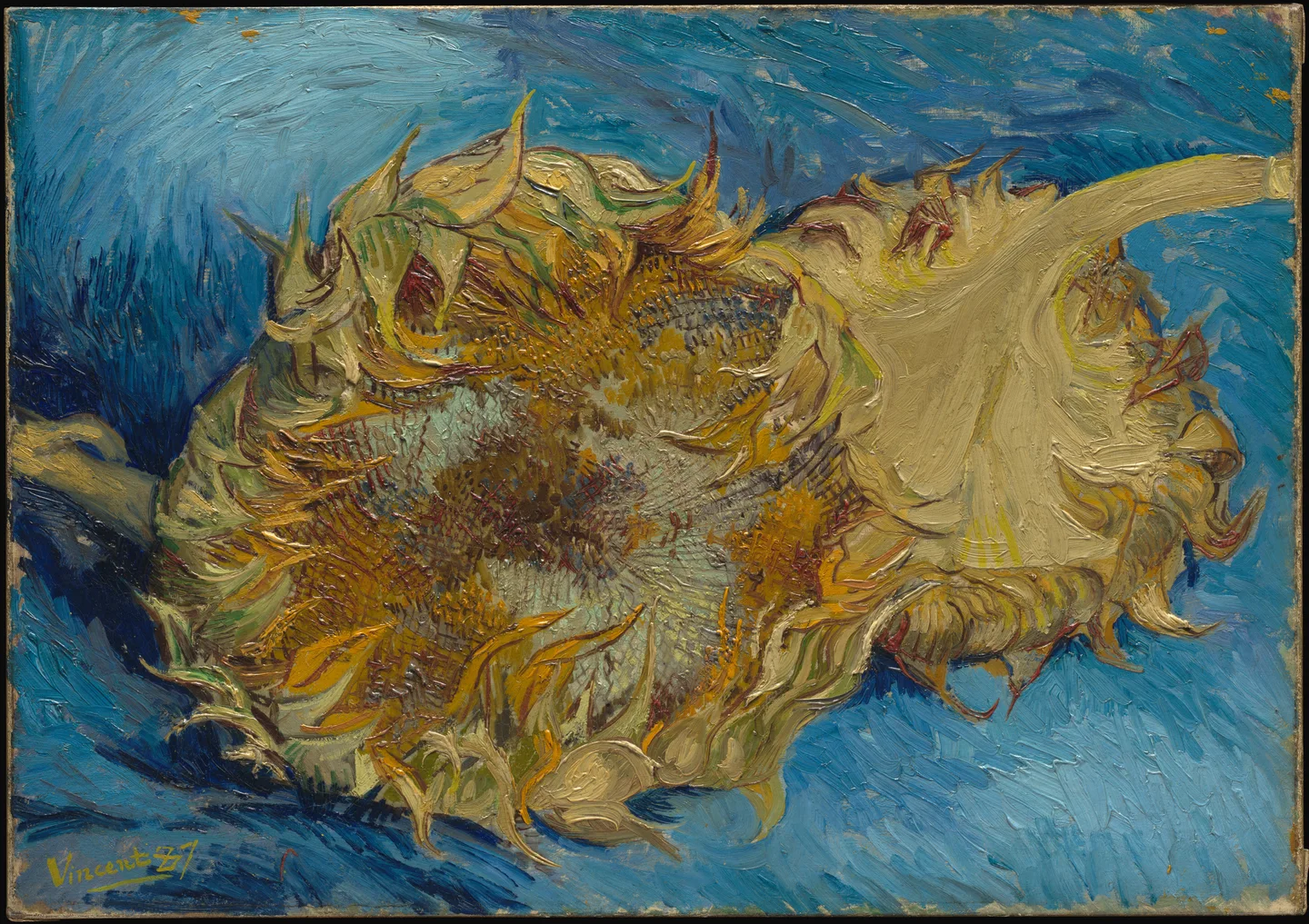
The paint itself can give a disk weight. Short, thick touches may make a seed head feel quite different from the wide area of color filling a vase. In a small reproduction both appear yellow, so examine the direction and density of marks. The guide to Van Gogh's paintings follows these differences beyond still life to painted chairs, faces, and night skies. A mark that depicts a petal in one work can perform an entirely different job elsewhere. His Paris Sunflowers show cut heads lying against blue. Compare the contour of a flower on its side with one seen almost frontally in the London vase.
Move the flower out of the vase
Monet's water lilies spread across a pond. Their stems are largely hidden, and the flowers share the visible surface with reflections from above. A lily pad can seem to float on a sky until a neighboring leaf restores our understanding of the water. Check which edges lie flat and which marks suggest depth below the surface. Compare that with the dense upright construction of a vase painting, where an ordinary understanding of gravity keeps the display organized.
Georgia O'Keeffe often enlarged floral forms until petals reached or exceeded the frame. In Black Iris, a viewer can follow the folds from dark interior areas toward lighter surfaces. The increase of scale changes the flower's relationship to a human body looking at the picture. In reading a modern painting, a crop can become the beginning of an inquiry into shape as well as subject. Other examples of botanical subjects are collected in the famous paintings topic. For a flower that gives you no vase or shelf to measure against, follow the reflections in Monet’s water-lily paintings.
Frequently asked questions
How can I tell whether a flower has a symbolic meaning?
Look for historical evidence connecting that species and setting with a particular association. A lily held by a figure in an Annunciation belongs to a different visual tradition from a lily observed on a pond. The specific format, subject, and period can help narrow possible meanings.
What if I lose the stem before it reaches the vase?
Trace the visible stretch from the flower head down, then begin again at the rim and work upward. If leaves hide the middle, describe the two stretches separately. A pencilled dotted line can preserve the difference between a path you see and one you infer.
Follow a stem to the edge
Choose one flower projecting beyond Ruysch’s bouquet. Can you trace its stem all the way to the vase? Mark the first point where you have to infer its path.