How to Read a Modern Painting
How to read a modern painting: start with color and shape, then ask what the artist left out, and what the title adds.
Learning how to read a modern painting is easier if you begin by asking what your eyes have to do. Can you settle on a single viewpoint? Does a contour separate two objects, or does it belong to both? The same close-looking method for reading a painting works for a recognizable street and a field of color. Modern painting encompasses artists who pursued quite different aims. It pays to give each work a question that its particular surface can answer.
Begin with a stubborn feature
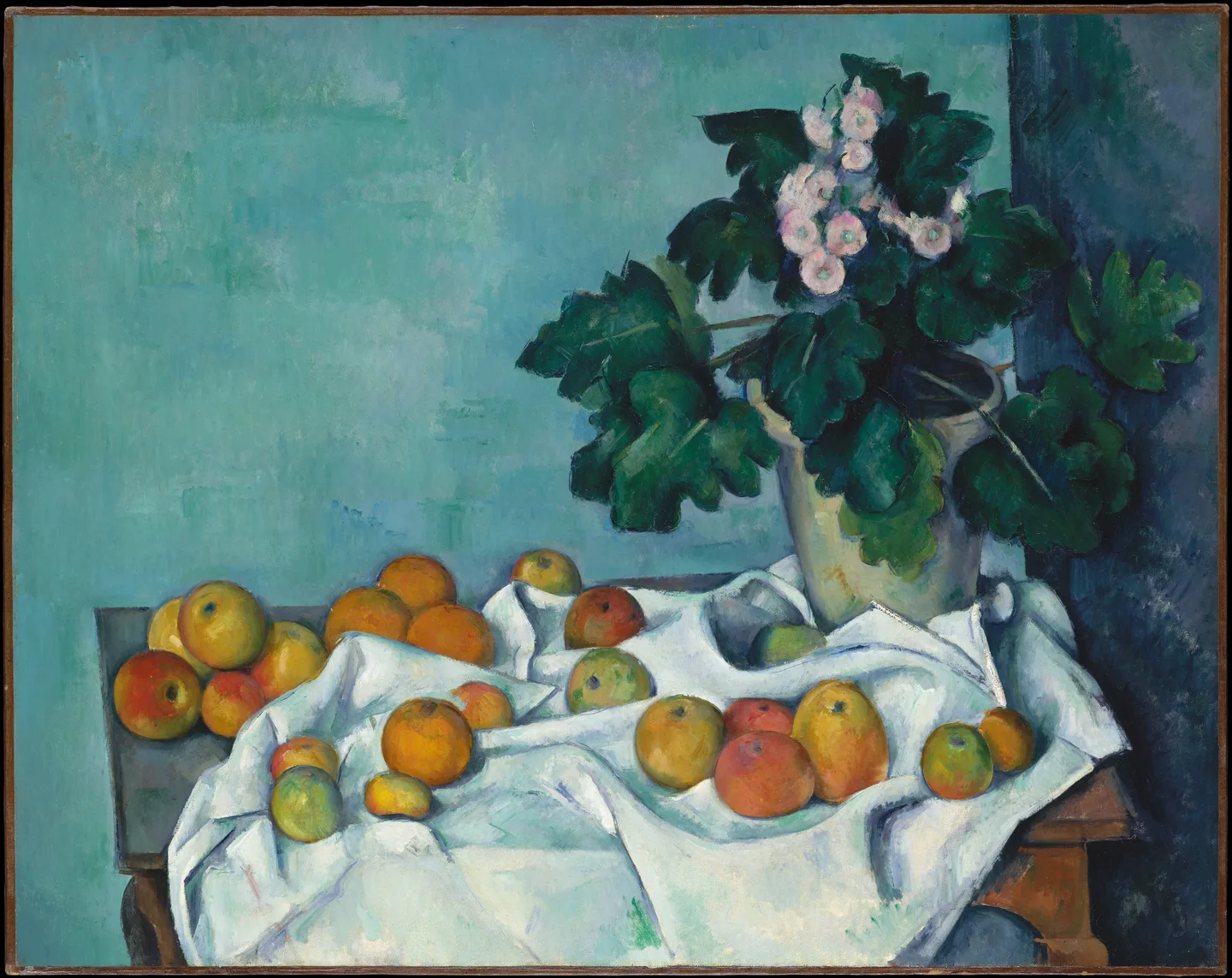
Open Paul Cézanne’s Still Life with Apples and a Pot of Primroses. The fruit, cloth, and flowerpot are easy to name, yet the tabletop seems to tilt toward you. Lay a strip of paper along an exposed section of the table edge and extend its direction across the interruption. Start again at the far side and extend that section back toward the first. Mark where the two paths would meet, or the distance by which they miss. Choose one fruit and follow its edge. Small changes from warm to cool color can give it weight even where the surrounding space feels unstable. Those two experiences can occur in the same small part of a canvas.
Ask what an orderly one-point perspective would change. A stable table might make the room easier to enter in imagination, while drawing attention away from the separate acts of looking that make up the surface. You do not need to diagnose a painter's eyesight or intentions to describe that effect. A careful sentence can stop at what you can show. The rim of the flowerpot is visible from above, while the folds of white cloth carry the eye across the front edge of the table.
Let a title propose a test
In Piet Mondrian's Broadway Boogie Woogie, the title offers two leads, a street system and a musical rhythm. Follow one yellow band as it crosses the square. Small blocks of color interrupt it at irregular intervals. Another band carries your eye away from the first. The painting gives a viewer many possible routes and no single figure to follow. Count the intervals between red patches on one route, then compare the result on a parallel route. Repetition has acquired accents.
Try a different test for what an artist has left out. Compare Mondrian's Gray Tree with Flowering Apple Tree. In the first, a dark trunk and branching limbs make the subject fairly easy to reconstruct. In the second, curved fragments run into the spaces around them. Cover the title. Where can you still tell branch from air, and where do you lose the distinction? In the famous abstract paintings guide, the interval between marks sometimes carries information that a continuous outline supplied in an earlier work.
Find where material becomes part of the subject
Consider a Cubist collage that incorporates a piece of printed newspaper. Letters printed in regular rows have an order independent of the painter's hand. A torn edge interrupts those rows and announces the paper as a physical piece. In a reproduction, you may see a photograph of a shadow in the newspaper beside the actual shadow cast by the collage. Read the medium line closely. If a work uses painted imitation wood grain, a convincing texture can be evidence of an illusion inside an intentionally flat arrangement.
Practice grouping pictures by one criterion in Odd One Out. Try distinguishing repeated shapes from repeated objects. Five circles might represent five pieces of fruit, or they might simply divide a surface into intervals. With a group, ask everyone to propose one feature that could survive a very small reproduction and one that would require an original-size detail. Color placement and changes of paint thickness usually make different demands on the reproduction.
Record an uncertainty you can investigate
A modern portrait can make a face legible from across a room and difficult to assemble when viewed closely. Spend one pass on the recognizable figure and another on where outlines stop, change direction, or merge into the ground. Add a sentence about scale, as in the seven-step art appreciation exercise. A form the size of your hand addresses the body differently from an equally proportioned form that stretches from floor to ceiling. A museum's recorded dimensions let you test this even when the work is online.
Now identify a question for research. An early exhibition review can tell you what surprised an immediate audience. A conservation photograph might reveal changes to a composition. A statement by an artist gives one account of a process, sometimes written long after the event. Keep the evidence attached to its source. The details and differences collection offers other exercises for moving from a puzzling patch of a picture to a question that has an answer.
Frequently asked questions
Is every modern painting abstract?
Modern painters also made recognizable street scenes, landscapes, portraits, and still lifes. Some works move between representation and abstraction within a single composition. To characterize a particular picture, describe how much information about the subject remains and where the painter asks color or shape to carry the argument.
What if the reproduction looks like a completely flat block of color?
Check the medium, dimensions, and any available installation view. Subtle changes in gloss or brush direction can disappear in digital capture. You can still discuss the size and placement of the colored area relative to its support. Mark any claim about texture as something to revisit when better visual evidence becomes available.
Try the two edges again
Cover the middle of Cézanne’s table with a slip of paper. Trace the exposed edge from each side and compare where your marks finish. Record the mismatch that you want the label or a closer look to explain.