Famous Van Gogh Paintings
Famous Van Gogh paintings: Starry Night, Sunflowers, and more, with the colors, brushwork, and stories behind them.
Famous Van Gogh paintings can make a viewer feel that every stroke is moving in the same urgent way. Look closely and that impression breaks into a surprisingly varied vocabulary. Marks can describe a potato, enlarge a seed head, hold a wall flat, or make a field advance toward you. The guide to famous paintings shows how a remembered detail can lead back to a larger arrangement. Here the test is to name what a stroke actually does in six very different paintings.
A meal and a room give ordinary things weight
In The Potato Eaters, five people gather around a small meal under a hanging lamp. The rough surfaces and dark, earthy colors belong to Van Gogh's Dutch years. Look at the sequence of hands and the space between serving, taking, and drinking. Light catches foreheads and cheekbones, then finds the food at the center. The lamp makes a modest circle of shared activity in a room where much of the surrounding space stays dark.
Compare The Bedroom, painted after the artist moved to Arles. Strong colors separate walls, floor, chairs, and bed. The room is empty, yet a pair of pillows, clothes on pegs, and pictures on the wall make its occupant imaginable. The bed appears to swell toward the lower right of the canvas. Trace the receding edges to see where a comfortably familiar room becomes surprisingly difficult to map. Several versions survive, with differences in details and present color. Choose one version before comparing it with the artist's drawn or written descriptions.
Sunflowers and a postman become recurring subjects
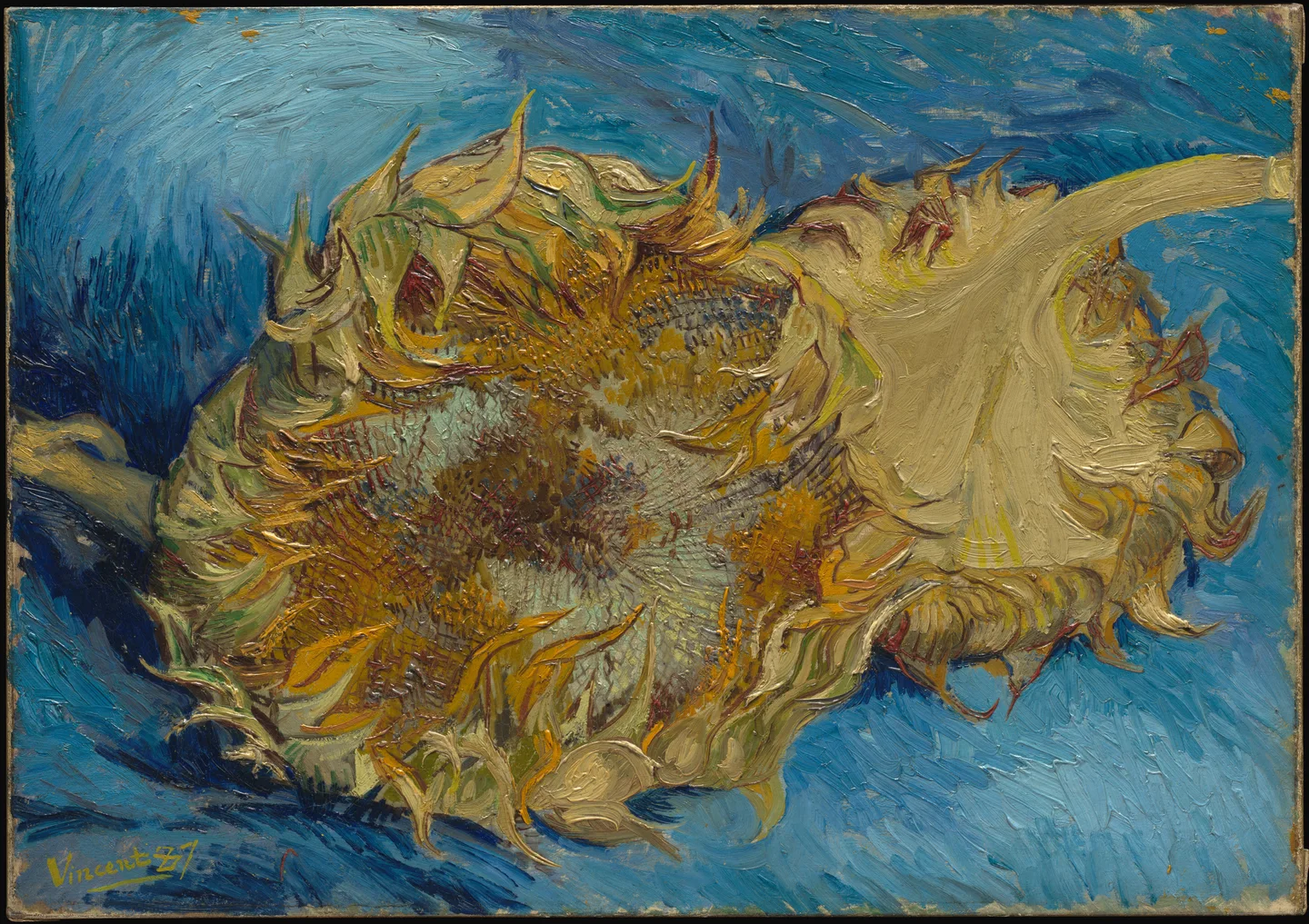
Van Gogh made sunflower studies in Paris and a group of vase paintings in Arles. In the National Gallery’s Sunflowers, flowers can be nearly the same color as their setting while remaining distinct through thickness, contour, and direction of marks. Look for one head viewed frontally and one viewed from behind. The first can become a great disk. The back may appear bristly or star shaped. The flower painting guide sets these forms beside bouquets that use smooth surfaces and sharp botanical distinctions. In the Met’s Paris Sunflowers, two cut heads lie on a blue surface. Cover one flower and compare what the seed disk and petals tell you about the angle of the other.
Joseph Roulin, the postman who befriended Van Gogh in Arles, also sat for repeated portraits. A uniform and cap permit identification, while the treatment of the beard, background, and clothing varies. Try dividing one portrait into decorative pattern and bodily volume. A beard can belong to both categories, a recognizable part of a face and an area of repeated curving marks. Repeat portraits document an ongoing relationship as well as giving a painter opportunities to try new backgrounds, arrangements, and color combinations. Compare the changes between bouquets with the series Monet painted at Rouen. Cut flowers change as Van Gogh works. The cathedral facade holds its shape as the light moves.
Two night skies ask different things of color
Compare Starry Night over the Rhône, Arles, 1888 (Musée d’Orsay) with The Starry Night, Saint-Rémy, 1889 (MoMA). Put a finger on the riverbank in the first image, then find the cypress in the second. Each gives you a different way into a night sky.
Starry Night over the Rhône, made in Arles in 1888, shows artificial lights across the water and long reflections running down toward the viewer. Small figures occupy the near bank. You can identify a horizon, water, and sky quite readily, although the reflections extend the city's light far beyond the buildings themselves. Look for a vertical streak that breaks into shorter strokes. Those breaks turn a bright straight line into something that seems to move on a river.
The Starry Night of 1889, made at Saint-Rémy, replaces the wide river with a village, hills, and a large cypress rising into the sky. A church steeple offers a smaller upward thrust. Compare those two verticals with the broad curves above them. The painter drew on observation and invention, so there is little reason to demand a photographic match to the view from a particular window. The Post-Impressionism guide places this synthesis beside other late nineteenth-century responses to the world visible outdoors.
Make a study of direction
Draw a small grid and give each cell one kind of mark from a reproduction. A short straight stroke, a curving dash, a heavy contour, and a smooth area of color can all come from the same canvas. Record the thing each mark describes. Does the mark follow the surface, cut across it, or continue its movement into a neighboring shape? Play Match the Detail and name the particular edge, texture, or color joint that put a crop back into its original setting.
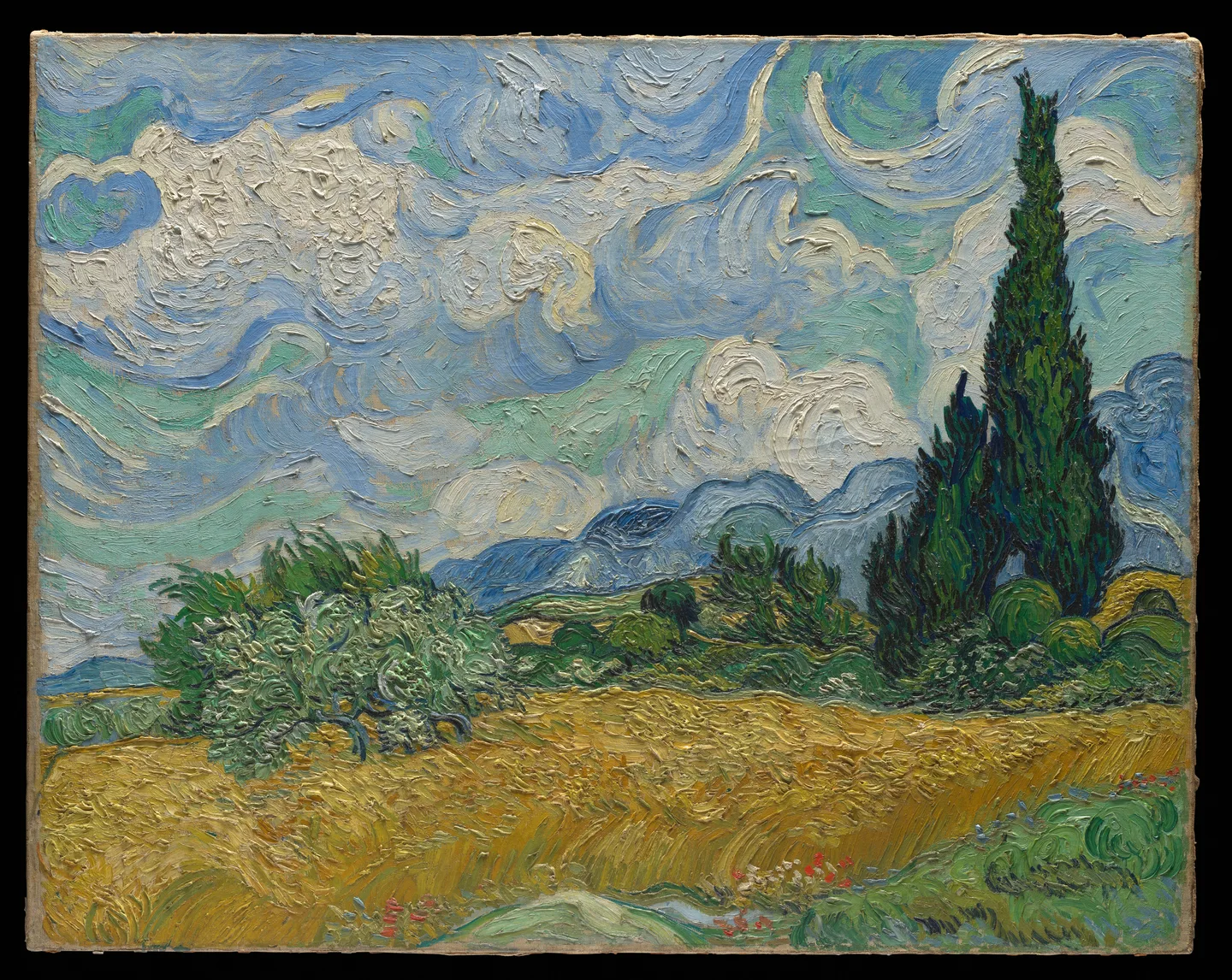
Size matters to this exercise. A short mark in a reproduction might be a stroke broad enough to see from across a gallery. Read the work's dimensions and look for a detail photograph when possible. The famous paintings topic includes painters whose handling can appear similar in reproduction yet behaves very differently at its actual scale. Try the field in Wheat Field with Cypresses. Follow a short stroke that bends with the crop and then a much longer curve in the clouds. In Picasso’s The Old Guitarist, the angle of a limb helps you assemble the body. See if a single stroke in Van Gogh can guide you as far as a contour does there.
Frequently asked questions
Was every Van Gogh painting made with thick impasto?
No. Impasto describes paint thick enough to project from its support. Van Gogh varied his handling across works and even within a single surface. A thin passage or exposed ground can contribute as much to a composition as an especially raised mark.
What should I sketch to remember which night scene I saw?
Draw the boundary below the sky in each painting before adding a single star. If you remember a horizontal riverbank and its reflections, that outline will differ from a tall cypress against hills. Check your sketch against the two museum images in the night-skies section.
Follow the lights down to earth
Compare a reflected streetlight in the Arles painting with the church steeple in the Saint-Rémy painting. Which vertical mark changes direction on its way down?