Post-Impressionism Art Movement
Post-Impressionism art movement: bold color and structure after Impressionism—how to recognize it.
Was there one art movement after Impressionism? The usual introductory answer is Post-Impressionism, a term that brings together artists who pursued strikingly different questions. Paul Cézanne explored how color can build volume, Georges Seurat investigated structured color relations, Vincent van Gogh used directional marks, and Paul Gauguin composed broad areas of saturated color. The introduction to art movements explains why a retrospective label differs from a group with common membership. Use the four sections as a viewing card. With Cézanne, extend the table edge. With Seurat, step back from adjacent touches. With Van Gogh, trace a change of stroke direction. With Gauguin, follow the contour against the red ground.
Cézanne makes a tabletop difficult to measure
In The Basket of Apples, a basket tilts, a cloth billows, and the edges of the table seem difficult to reconcile across an interruption. Individual apples still have convincing fullness. Track a shift from warm to cool color around a fruit and compare it with the harder contour where a neighboring object meets the cloth. A painter can make a single apple feel substantial while disturbing the easy reading of the larger space in which the apple sits.
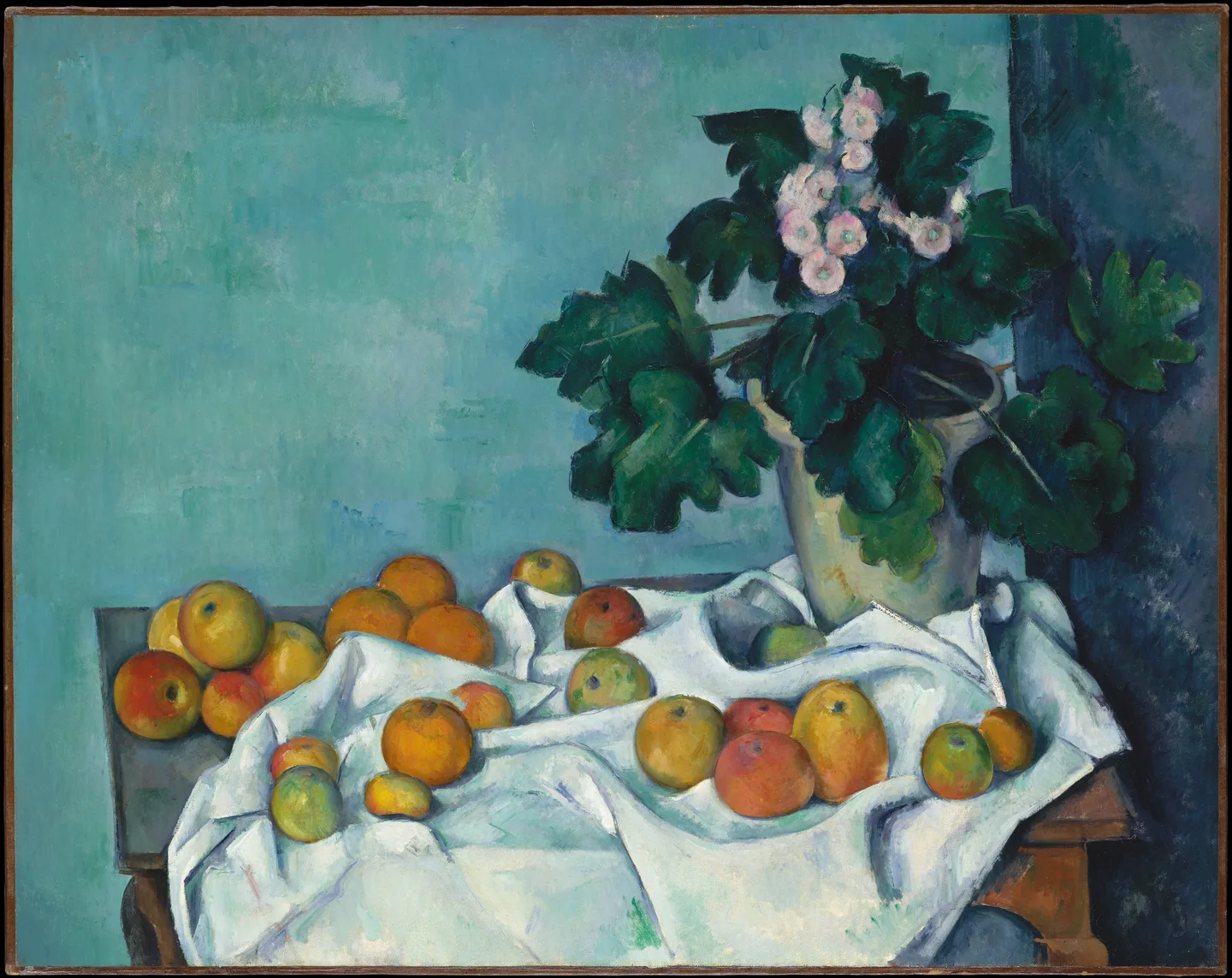
Now look at Cézanne's Still Life with Apples and a Pot of Primroses, the Met work shown here. Pick a fruit near the front and trace its edge until it disappears against the white cloth. A neighboring fold gives its position away even where a continuous outline would be difficult to draw. Above the fruit, small pink blossoms sit within a dark mass of leaves. They seem small partly because the apples give us something familiar to measure them against. The guide to reading a modern painting develops a related exercise with the interrupted edge of a table. Try tracing both a fruit and a piece of furniture before concluding that Cézanne handles every boundary alike.
Seurat organizes leisure through a system of contrasts
In A Sunday on La Grande Jatte, figures in fashionable dress gather near the Seine. Their carefully spaced profiles make the scene feel partly like a frieze. Small marks of color create a surface that changes with viewing distance. Do not assume every part of a painting was made by identical dabs applied in one session. Seurat developed the picture over time. A photograph of a detail can show distinctions in the marks that a full-page reproduction smooths into a general texture.
Seurat participated in the last of the independent Impressionist exhibitions in 1886. The term Neo-Impressionism is more specific to the systematic color practices associated with him and artists including Paul Signac. The Impressionism guide describes the institutional history that made such an exhibition possible. Seurat's presence there also shows why one movement ending and another beginning on consecutive calendar dates can be a misleading picture of how people, exhibitions, and experiments actually overlapped.
Van Gogh bends a brushstroke around a subject
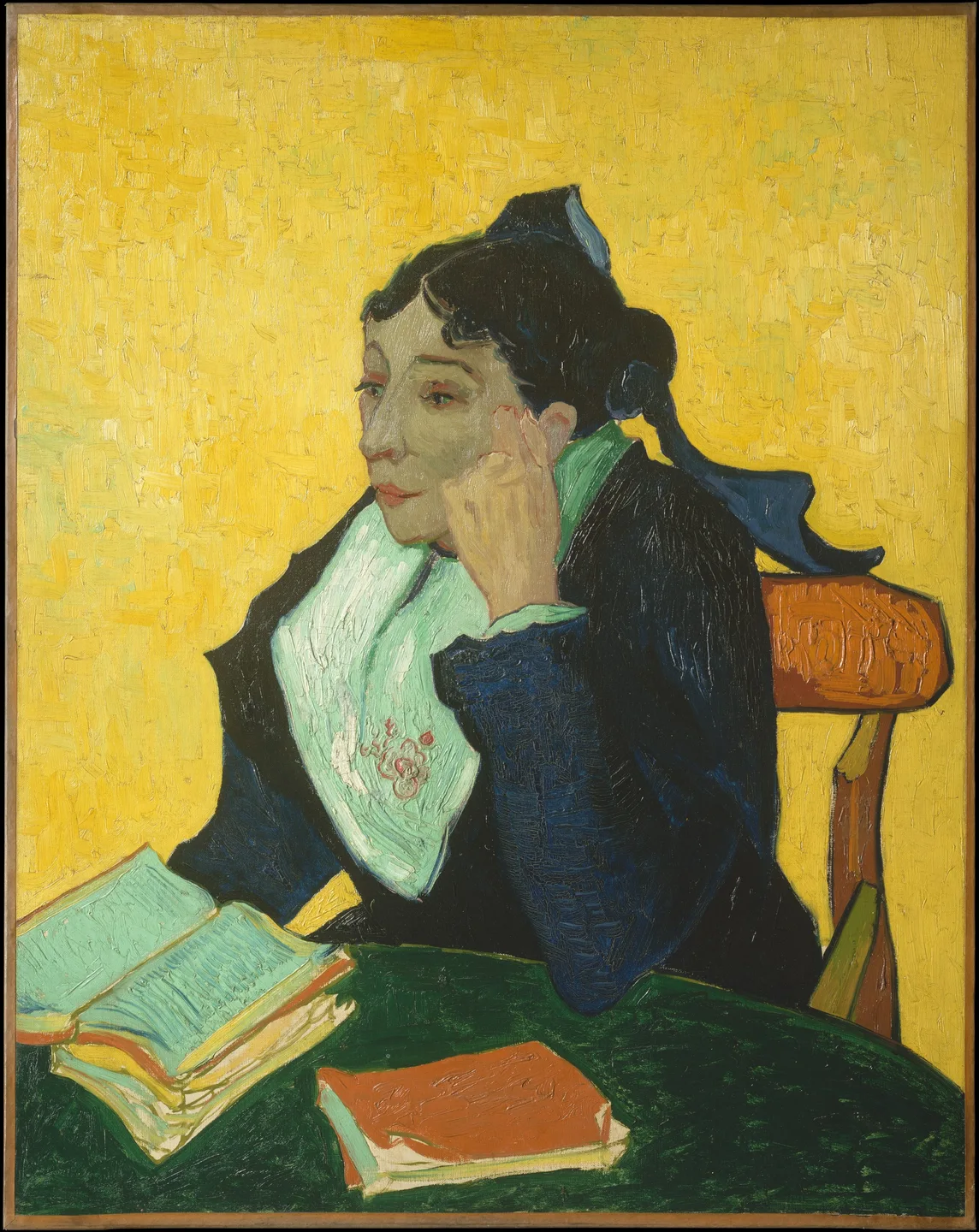
In Van Gogh's L’Arlésienne (Madame Joseph-Michel Ginoux), shown here, the sitter rests her head on one hand. The bent arm follows the dark bulk of the dress. Against the yellow wall, the silhouette of her hair and its trailing ribbon stays readable even if the details around her eyes disappear at a distance. Look down at the two books. The red cover of the closed volume makes a distinct angle beside the fanning pages of the open one. The change from a curved silhouette to short, squared-off edges is one way Van Gogh keeps a nearly flat table and wall from swallowing the figure.
Compare her ribbon with the top of the trees in Van Gogh's Cypresses. Inside the foliage, green marks curl back into each other. At the outer edge, those same turns make small notches against the pale sky. Hold a piece of paper over the sky so only the inner marks remain visible. Some of the sense of upward movement survives; the impression of a single, towering tree depends much more on having its silhouette back. This is a more precise question than asking whether a swirling brushstroke expresses Van Gogh's state of mind. You can test it with your eyes. Trace one contour in the Romantic landscapes of Friedrich, then one of Van Gogh’s cypresses. Do separate strokes announce the contour or disappear into it?
Gauguin lets a color field carry a vision
Gauguin's Vision of the Sermon depicts Breton women and a vision of Jacob wrestling with an angel. An angled tree trunk separates and connects parts of the composition. The red ground gives the vision unusual intensity while making conventional depth difficult to locate. Trace the shapes of the white caps against that red and look for places where contour carries more information than shadows. Color is helping to distinguish orders of experience as well as describing things in the world.
The label Post-Impressionism became especially influential through Roger Fry's 1910 London exhibition Manet and the Post-Impressionists. That exhibition looked back at recent work from a new place and time. The art history collection includes other cases where later historical labels sit alongside artists' own exhibitions, working relationships, and disagreements.
Frequently asked questions
Is Pointillism another name for Post-Impressionism?
Pointillism refers more specifically to a technique involving small, discrete touches, often discussed in connection with Neo-Impressionism. Post-Impressionism covers a broader group of artists and experiments. A Cézanne still life or Gauguin's broad red field can appear in a Post-Impressionist survey without using pointillist handling.
Did the Post-Impressionists reject outdoor observation?
Their interests and working methods varied. Cézanne repeatedly observed a particular mountain, while Gauguin's Vision of the Sermon includes a religious event experienced in imagination. Consider the specific picture's relation to observation, memory, structure, and symbolism before generalizing about the painters grouped under the later term.
Choose two of the four paintings
Keep one question fixed as you compare your pair. For example, follow the edge of Cézanne’s table and the edge of Gauguin’s red field. Which edge suggests depth, and where does that reading break down?