Romanticism Art Movement
Romanticism art movement: emotion, nature, and drama—how to recognize Romantic painting and what to notice.
The Romanticism art movement includes a storm seen from the sea, a back turned toward a fog-covered mountain, and a modern political uprising organized around an allegorical figure. Its name can suggest a single mood, yet its painters asked quite different questions about perception, history, imagination, and public life. The art movements guide places Romanticism alongside Neoclassicism, with which it overlapped. Begin by locating the position a painting offers its viewer. Is there a secure place from which to survey the event?
Friedrich puts a person between you and the view
In Caspar David Friedrich's Wanderer above the Sea of Fog, a man stands on a rocky height and faces away from us. The back of his coat, the angle of his leg, and his walking stick give the body a certain solid presence. The land ahead is much less secure. Tips of rock emerge through layers of fog. The viewer can imagine sharing the man's prospect but cannot actually occupy his exact position or inspect his expression.
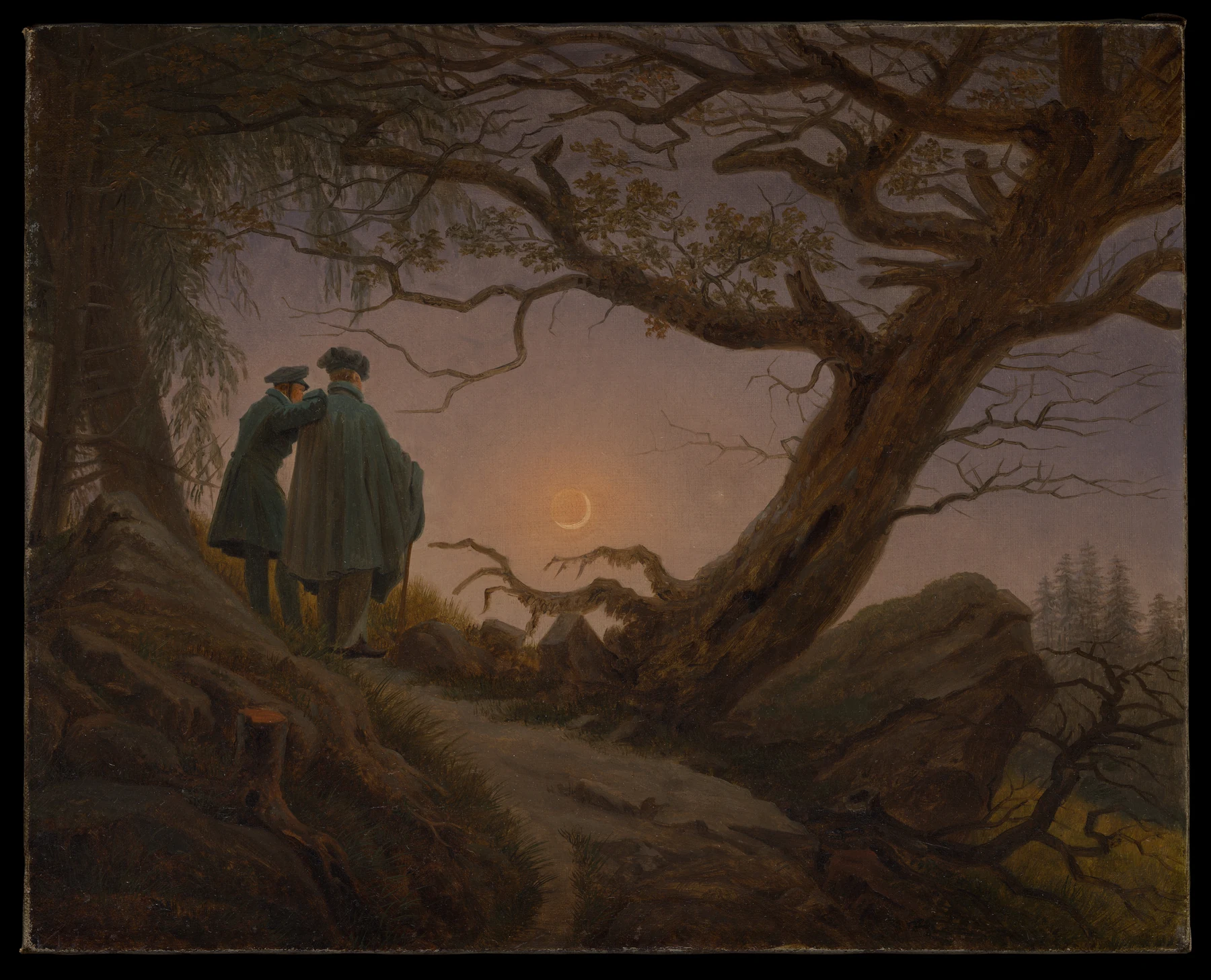
Compare his stance with Two Men Contemplating the Moon, the Friedrich landscape illustrated here. Two neighboring silhouettes give you two places to imagine standing. Follow the slope from their feet toward the leaning tree and then to the bright point between its branches. What changes when the pleasure of looking can be shared?
The term sublime can help describe an encounter in which scale or force exceeds ordinary human measure. It needs more support than a large mountain or dramatic cloud. In Friedrich, the relatively still human figure gives a unit against which an obscured, apparently extensive landscape can be felt. Cover the figure and look again. The remaining mountain forms still have depth, but the relation between a solitary observer and that depth has changed. Compare this arrangement with other famous landscape paintings.
Turner makes weather an event in the paint
In Turner's Snow Storm – Steam-Boat off a Harbour’s Mouth, a dark vessel is difficult to hold in view amid swirling marks. Find the few parts that allow you to identify the boat, then trace the curves that cross or envelop it. A vessel normally gives a stable point from which to understand wind and water. Here the atmosphere threatens to undo the distinction between the thing moving and the space through which it moves.
In Turner's The Fighting Temeraire, the pale, high-masted warship follows a much smaller black steam tug. Look at the old ship's yards. There is no spread of canvas carrying her forward. The smoke comes from the tug, the boat doing the work. Try covering the tug with your thumb. The taller ship might seem to be sailing into a glowing evening. Restore the tug and the same sky belongs to a final journey to the breaker's yard. Turner even restored the masts and rigging in paint. The Navy had stripped the ship of reusable fittings before she went to the breaker's yard. Picturing her at full height lets us see something the actual tow could no longer show: just how much power has passed from the warship to the tug. Steam also fills a station painted by Monet. In the station it can obscure the roof. In Turner’s tow scene it helps separate the working tug from the ship it tows.
Goya and Géricault make suffering public
In Goya's The Third of May 1808, a man in a white shirt raises his arms before a line of soldiers. The lantern on the ground illuminates the victims and leaves the executioners' faces largely hidden from the viewer. The painting dates to 1814 and represents events of an earlier uprising. Study how the repeated rifles make a collective shape, then compare that shape with the different postures of the people facing them. Repetition and individuality carry opposing kinds of force.
Géricault's The Raft of the Medusa refers to a contemporary shipwreck and political scandal. Bodies on the near side of the raft are interwoven with the makeshift structure. Farther up, survivors cluster around a figure signaling toward a distant ship. The viewer can follow an ascent from loss to the possibility of rescue, but the tiny scale of the distant vessel keeps the outcome uncertain. Compare the implied audience with that of a history painting celebrating a victory already secured.
Allegory can enter a modern street
Delacroix's Liberty Leading the People commemorates the July Revolution of 1830 in France. Liberty carries the tricolor and advances over a barricade among figures in contemporary dress. Is she a physical participant, a personification, or both? Her position above the advancing group gives the event a broad symbolic shape, while the bodies underfoot insist on its material cost. Follow the path from foreground to flag without skipping the uneven ground the viewer would have to cross.
Compare Liberty's raised flag with the father's raised swords in the Neoclassical movement guide. David makes the brothers' gestures converge under an arch. Delacroix puts Liberty's next step directly above fallen bodies. One practical way to test the difference is to sketch only the ground under the principal figures. In one painting, straight pavement lines give the oath a platform. In the other, an obstacle has to be crossed before the crowd can reach you. When looking up either work in the art history collection, record the painting’s date separately from the event it represents.
Frequently asked questions
Where should I look for the rescue ship on Géricault’s raft?
Follow the raised cloth toward the horizon at the right of the painting. The ship is so small that it can disappear in a reproduction. Enlarge the Louvre image, then return to the full composition and compare the tiny sail with the scale of the people signaling to it.
Can a carefully planned painting belong to Romanticism?
Yes. Géricault prepared extensively for The Raft of the Medusa, studying bodies, models, and the arrangement of figures. A viewer's experience of turbulence or emotional urgency can depend on highly deliberate research and composition. Identify what feels unstable in the depicted event and what holds the painted structure together.
Compare two places to stand
Set Friedrich’s moon watchers beside Turner’s storm. Find one edge that helps you locate yourself in each picture. Where can you still tell which way is up if you cover that edge?