Famous Landscape Paintings
Famous landscape paintings: a guide to landmark landscapes and the composition, light, and detail that make them work.
Read a landscape in three passes. Find your footing in the foreground, watch what air does to distant edges, and look for signs of human work. A wheel rut or a cultivated field may change how you understand a view that at first looked empty. A distant mountain can anchor a composition while a tiny path near the bottom determines how you enter it. The overview of famous paintings and their compositions introduces that relation between a detail and a whole work. With landscapes, try beginning at the frame's lower edge. What stands between your imagined position and the place where the picture seems to invite you?
Enter through the foreground
In Pieter Bruegel the Elder's Hunters in the Snow, hunters and dogs occupy the steep foreground slope. Their backs point us away from our side of the picture toward a valley filled with frozen water and small figures. Dark tree trunks separate the foreground from the lit distance without making a solid barrier. Draw three bands on paper to represent the slope, village, and hills. Then add the trees that cut across those bands. They connect spaces they also divide. In Bruegel’s summer The Harvesters, a single tree does much of this work. Follow it upward from the resting figures until its branches cross the farmlands in the distance.
Fan Kuan's Travelers Among Mountains and Streams makes the foreground an encounter with large rocks and trees. The procession that gives the work its English title can be easy to overlook beneath the mountain. Find a human-made or human-scale element and use it as a unit of measure. The extraordinary size of the mountain becomes palpable partly because of small signs of travel near its base. A crop of its summit would retain mass and texture while removing this large change of scale. Try covering the traveler in an ink landscape by Sesshu. Even a few strokes can be enough to give the surrounding peaks a scale.
Read the air as part of the composition
A distant hill can appear less distinct because of intervening air. Painters can communicate that impression by reducing contrast, softening edges, or adjusting hue. Follow a sequence of hills in a landscape and compare the darkest dark in each. If all the darks remain equally strong, the picture may organize its distance by other means. If they become successively lighter, the atmosphere is doing some of the work that a road or a scale change might otherwise perform.
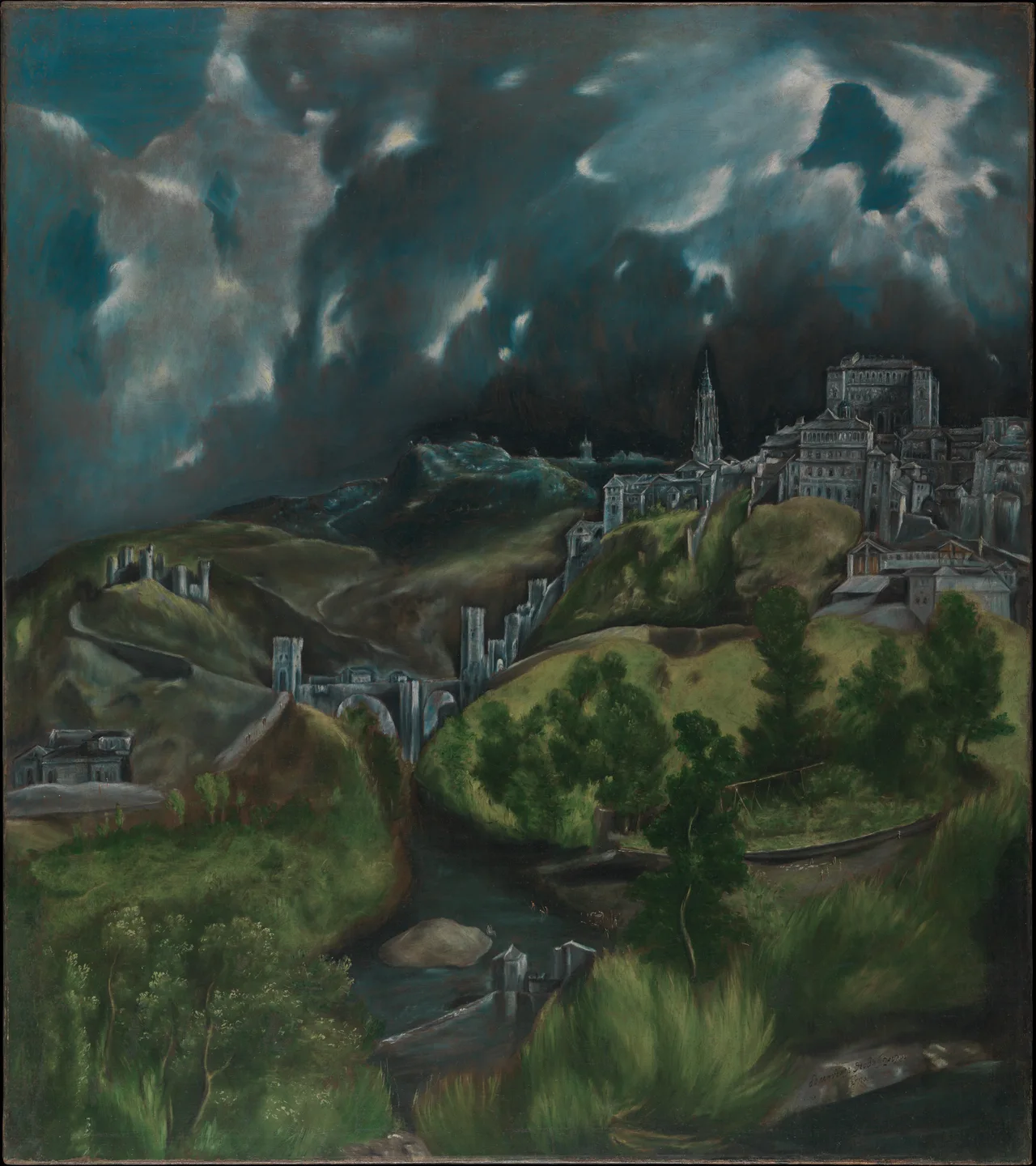
In Turner's Rain, Steam, and Speed, the locomotive approaches on a bridge through an atmosphere that confuses clear boundaries. A long diagonal supplies direction even when rain and vapor weaken the distinction between solid forms and the space around them. Try tracing the bridge before locating the engine. Then cover the engine and see how much forward movement the bridge still implies. Compare this approach with the Romantic movement's treatments of nature and scale. Set a second skyline beside the railway: in El Greco’s View of Toledo, the hillside and buildings make separate dark edges against the sky. Which edge gives the more reliable route through the scene?
Notice what people have changed
Constable's The Hay Wain shows a wagon in shallow water beside a cottage. Beyond the water and trees, the landscape opens onto fields. The river is part of a working environment that includes buildings, roads, and agriculture. Calling the scene untouched nature would overlook much of the evidence nearest the viewer. Ask which routes might be passable for a wagon, which areas are cultivated, and where human activity continues beyond the clearest outlines of people.
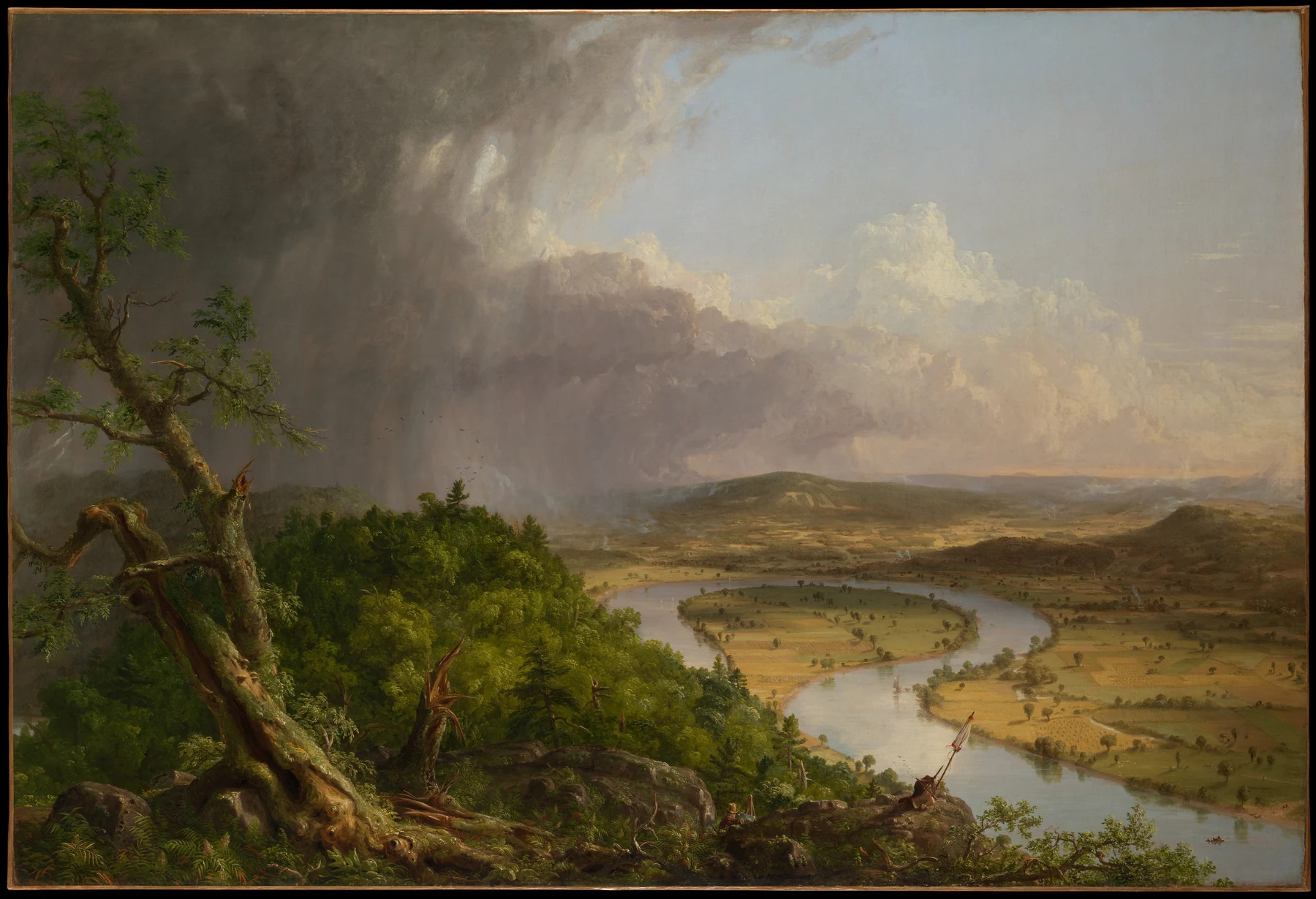
Thomas Cole's The Oxbow presents a high view across a bend of the Connecticut River. Weather and terrain divide the canvas broadly between a rough foreground and cultivated land in the distance. The painter included himself, small in relation to his surroundings. From that position the viewer can consider both the making of a landscape image and the changing uses of the land it depicts. A farm field may look like a patch of color from above even though it represents considerable labor at ground level.
Make a comparison with one thing held constant
Choose two landscapes containing water and compare only what the water does. In one it may reflect a skyline. In another it can carry traffic, divide space, or keep the viewer from reaching the far bank. Such a limited comparison often reveals more than listing ten incidental similarities. The landscape painters comparison guide follows several artists through questions about weather, labor, and viewpoint.
Try Spot the Difference with a landscape and give each change a location relative to a visible landmark. Behind the first tree is usually a stronger clue than somewhere on the left. Then make a sketch using only five shapes. Include whichever overlap best establishes depth. Check what your sketch sacrifices when a single foreground branch or distant roof goes missing. The famous paintings topic contains further examples where a very small feature can change the reading of considerable space.
Frequently asked questions
Is a landscape still a landscape if it includes a story?
Many landscapes include travelers, biblical events, battles, labor, or leisure. Ask how attention is distributed. A small narrative incident can give a viewer a reason to explore a much larger environment, while the setting may alter the significance of that incident.
Is the horizon always the line where land meets sky?
The visible silhouette of roofs, trees, or mountains can sit well above a viewer's eye level. In a perspective construction, the horizon relates to that eye level. Receding parallel lines may help locate it even when a hill or a building hides the actual distant view.
Keep the water in view
Compare the water in The Hay Wain and The Oxbow. Find one place where it carries a person or vehicle and one where it helps you see the shape of the land.