Landscape Paintings by Famous Artists
Landscape paintings by famous artists: compare Constable, Turner, Monet, and more, and learn what to look for.
Comparing landscape paintings by famous artists is easiest when the two views answer the same question. How much sky does each artist allow? What tells you whether the air is moving? What work is being done on the land? The guide to landmark landscape paintings introduces the main compositional tools. Here the exercise is to hold one subject steady while moving between the decisions made by Constable, Turner, Monet, and artists working with quite different formats and ideas about place.
Constable and Turner find two kinds of weather
What makes one pale form stand out against a changing sky? Follow the edge of Constable’s spire, then the edge of Turner’s ship. Notice where you first lose either silhouette.
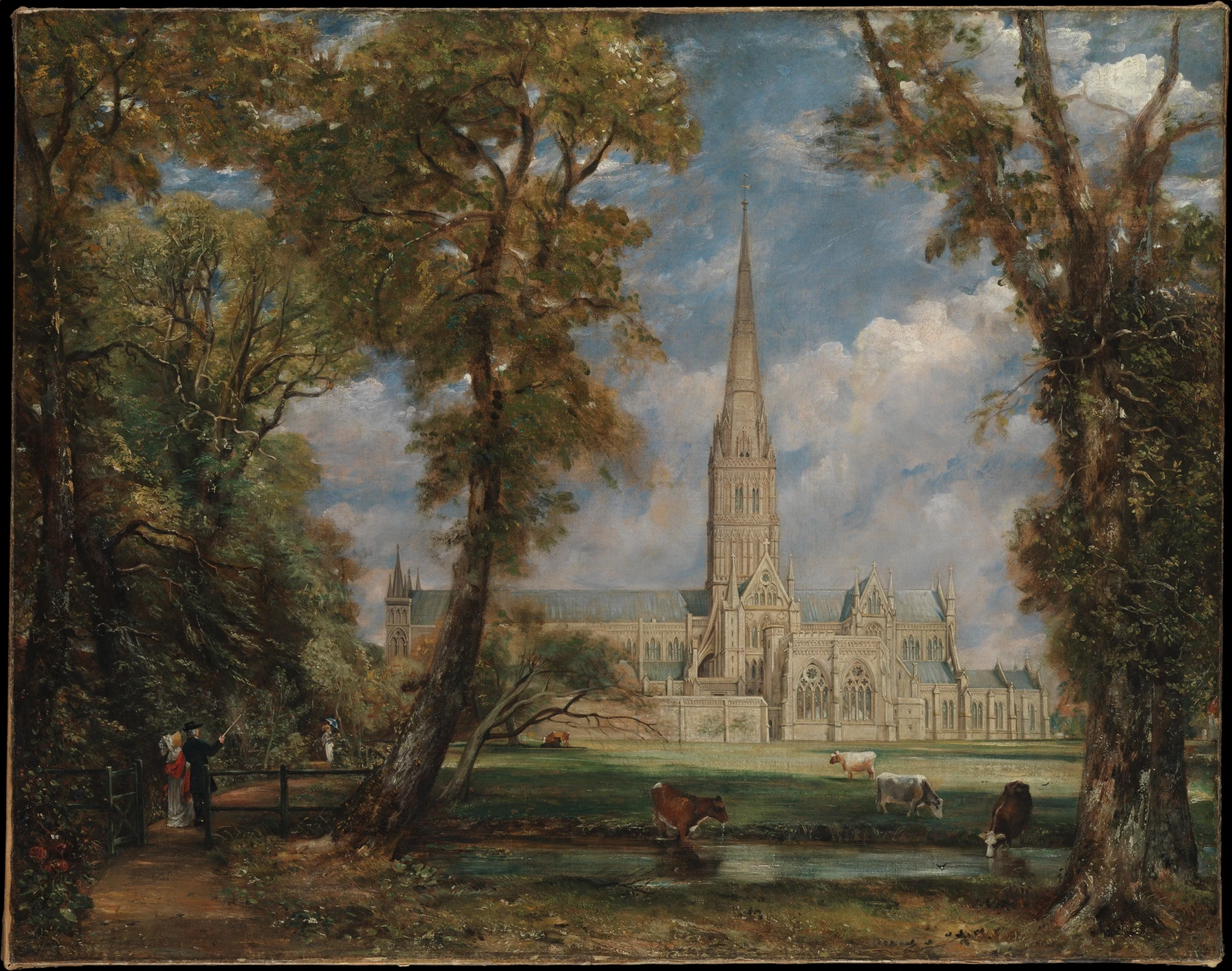
John Constable's Salisbury Cathedral from the Bishop's Grounds places a bright tower between dark trees. Cattle stand by the water and a tall tree sends limbs into the upper part of the canvas. Try tracing a route from the water to the cathedral without crossing a dark patch. The luminous building owes some of its prominence to the arrangement of surrounding foliage. Several versions exist, so identify the specific canvas before comparing the amount of blue sky or the shape of a cloud.
Turner's The Fighting Temeraire also leads a viewer toward a large, pale form. A small dark steam tug draws the old warship toward its final dismantling. A sunset gives the light an emotional role in the story of changing naval technology. Compare the distance between the tallest part of the pale ship and the nearest dark area with the gap between Constable's tower and trees. Both artists use light against dark. Their pictures make quite different claims about what that contrast means.
Monet uses a place as a repeatable experiment
Monet painted the Seine near Argenteuil under different conditions, returning to boats, bridges, and riverbanks. In the National Gallery of Art’s 1874 The Bridge at Argenteuil, a cluster of masts interrupts the sky and the bridge stretches across the water to the right. Separate the image into broad bands of bank, river, bridge, and sky. Then restore the small marks of reflected color. The picture's scaffolding is relatively simple, while the surface of the water remains active almost everywhere.
A bridge gives you something to compare across several canvases. Count its visible spans, locate the horizon relative to its deck, and note whether the painter faced into the sun or away from it. A changed viewpoint can transform a bridge from a barrier into a route. Compare the river scenes with Monet's series and late water paintings. At Giverny he sometimes removed the distant bank altogether, making it much more difficult to decide where the viewer is supposed to stand.
Sesshu and Friedrich make different demands on a traveler
Whose footsteps could you follow? Find the tiny walker in Sesshū’s winter scroll, then try to find a route past the back of Friedrich’s traveler.
In Sesshu Toyo's Winter Landscape, an abrupt dark line creates a sheer edge near the middle of the hanging scroll. Buildings and a small traveler offer a measure of the broken terrain. Unpainted or lightly marked areas allow snow and air to occupy substantial space. Follow the traveler's possible route, pausing where the marks cease to describe a passable surface. The viewer's eye can cross a blank area more readily than a person on foot could cross the ground it implies.
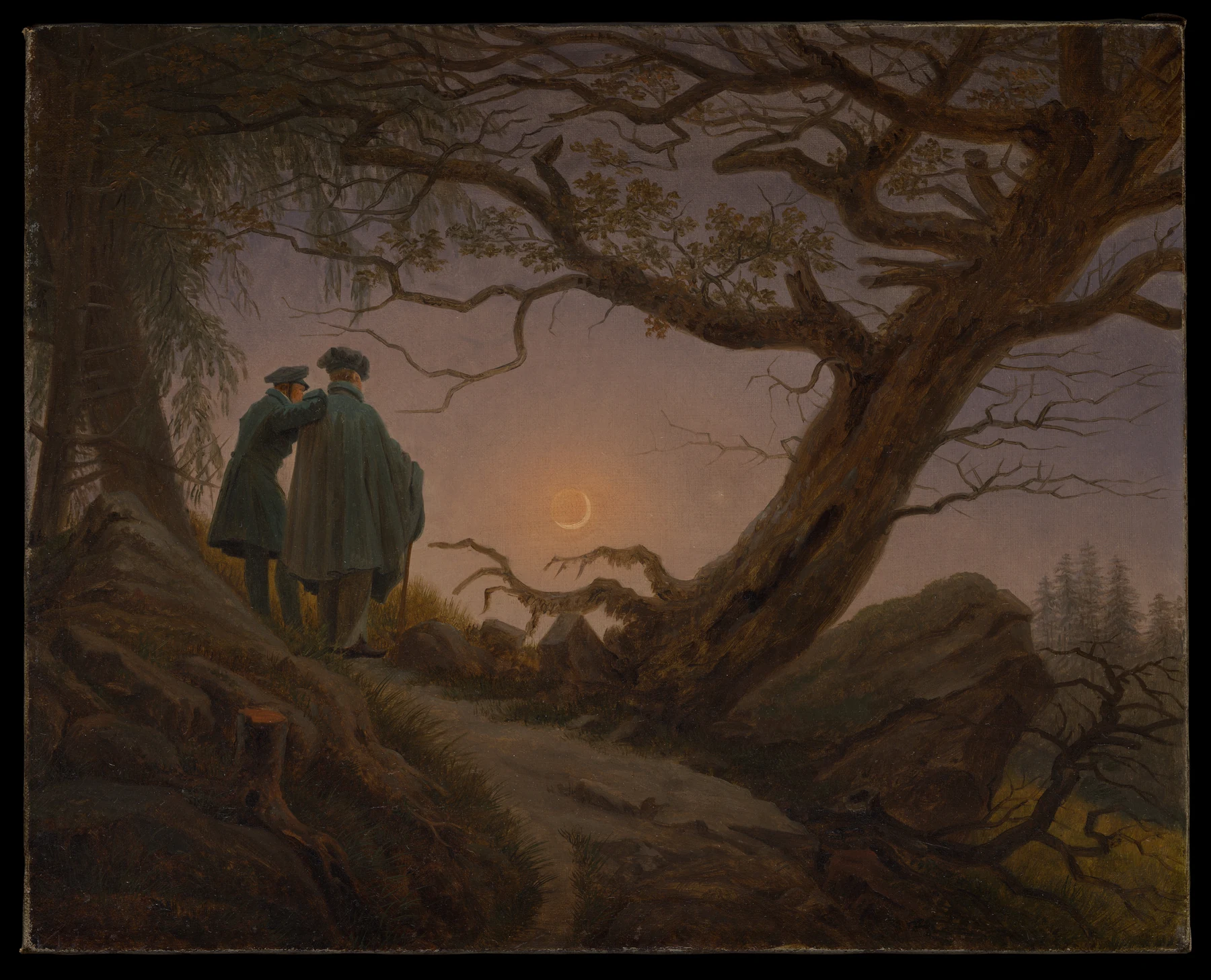
Caspar David Friedrich's Wanderer above the Sea of Fog puts the traveler directly between us and the view. His back occupies the center and his head rises above the fog. We see something like what he sees, but he also blocks the very position from which we might share his prospect. The guide to Romanticism explores this use of a figure facing away. Compare its function with the small figure in Sesshu's landscape, where sheer differences of scale dominate the encounter. Now open Friedrich’s Two Men Contemplating the Moon. Compare the amount of the view that two backs can block with the gap still visible beyond their shoulders. Look at the crease between panels in Japanese painted screens. A change in the physical angle of the support can redirect a path through the hills.
Make a sheet of paired observations
Divide a blank page down the middle and reserve each row for one comparison. Use horizon, nearest object, smallest visible person, and evidence of labor as row titles. Fill the same row for both paintings before moving to the next one. A missing feature also counts as information. In a water-lily painting with no visible horizon, reflections can tell you about the sky even when every square inch of painted surface seems to describe water.
Try Find It in the Painting and give a target's location using an immovable landmark. Then return to the famous paintings collection and choose two landscapes from distant periods. Use your comparison sheet to write a claim each picture can support. A comparison of atmosphere requires an actual statement about the edges, colors, or contrast in both images. A difference in the countries on the labels gives context but does little on its own to account for what your eyes encounter.
Frequently asked questions
Should I compare landscapes of exactly the same location?
Two views of one place are excellent for investigating differences of light, framing, or season. Different places can also support a comparison if you give them a shared question. A river, coast, or mountain pass can function as a route, an obstacle, a workplace, or a point of orientation.
How can I compare an oil painting with an ink landscape fairly?
Use a question both can answer, such as how near and far forms are separated. Note the role of paper, silk, canvas, washes, or opaque pigment in each solution. Comparing visible decisions will take you farther than expecting either material to resemble the other.
Copy a paired observation sheet
Work A: ___ / Work B: ___. Horizon: ___ / ___. Smallest person: ___ / ___. One dark edge against light: ___ / ___. What changes when you cover it: ___ / ___.