Famous Japanese Paintings
Famous Japanese paintings: from ukiyo-e to modern masters, with the lines, colors, and subjects to look for.
Famous Japanese paintings often reach viewers in photographs that make a long handscroll, a pair of screens, and a hanging scroll appear almost the same size. Restore their formats and they begin to ask different things of you. The guide to famous paintings discusses how a reproduction changes an image's setting. In Japan, the difference can include whether a viewer encounters a scene all at once, discovers it section by section, or watches the picture change as the angle between hinged panels shifts.
A handscroll lets an episode unfold
The illustrated Tale of Genji (painted handscroll) preserves scenes from the literary classic associated with Murasaki Shikibu. In some scenes the roof seems to have been removed so that a viewer can look down into rooms. Angled beams, screens, and partitions help separate people who occupy the same dwelling. Identify one barrier and ask who can see whom. A richly colored area of clothing can mark a person's presence even when an expression is difficult to read.
A traditional Japanese handscroll is viewed in successive passages as it is unrolled from right to left. Text and image can alternate. A museum photograph that lays out a very long section at once gives immediate access to relationships the original reader would have discovered through memory and anticipation. Try covering the photograph with two sheets of paper and moving a small window across it. A doorway can become a surprise, and an earlier room can help you interpret a later one after it has passed out of sight.
A screen paints the space of a room
In Hasegawa Tōhaku’s Pine Trees (a pair of ink folding screens), clusters of dark trunks and branches appear and disappear in mist. Some trees stand close enough for their marks to be distinct, while more distant forms are scarcely differentiated from the unpainted support. Fold lines create another set of verticals across the image. Look for a tree whose trunk roughly follows a fold, then find one that crosses it. You can imagine how different angles of installation would change the relation between those lines.
Ogata Kōrin’s Irises (a pair of folding screens) arranges bright clusters of blue blossoms and green leaves across gold grounds. The interval between clumps matters as much as the shape of one flower. With the panels standing at an angle, light responds to the gold in ways a flat reproduction can only partially convey. Try mapping the clumps with a few blue dots. The spacing may be easier to remember than the outline of any one petal. Compare how artists organize vegetation in the landscape painting guide.
An ink landscape puts weight on a few strokes
The winter view in Sesshū Tōyō’s Autumn and Winter Landscapes (a pair of ink hanging scrolls) constructs a formidable slope from angular marks, dark outcroppings, and light expanses. A small figure and buildings suggest a route through a place that might otherwise be hard to measure. Identify a stroke that describes a rock face and a patch of untouched or lightly marked surface that implies snow. Neither has to give a complete account of the terrain. Its neighbor supplies part of the information needed to read it.
A hanging scroll can be displayed vertically for an occasion and rolled away for storage. Its proportions encourage a different progression from reading a handscroll or moving alongside a folding screen. A viewer can look from a small traveler toward a distant height without moving either hand. Use Find It in the Painting to practice locating an object in relation to a much larger shape. Then try describing a winter landscape without using the words empty or minimal. Specify exactly which parts carry the information. Place the ink landscape beside Friedrich’s back-turned figure in the comparison of landscape painters. Where, exactly, would a viewer have to stand in each scene?
Distinguish a painted surface from a printed design
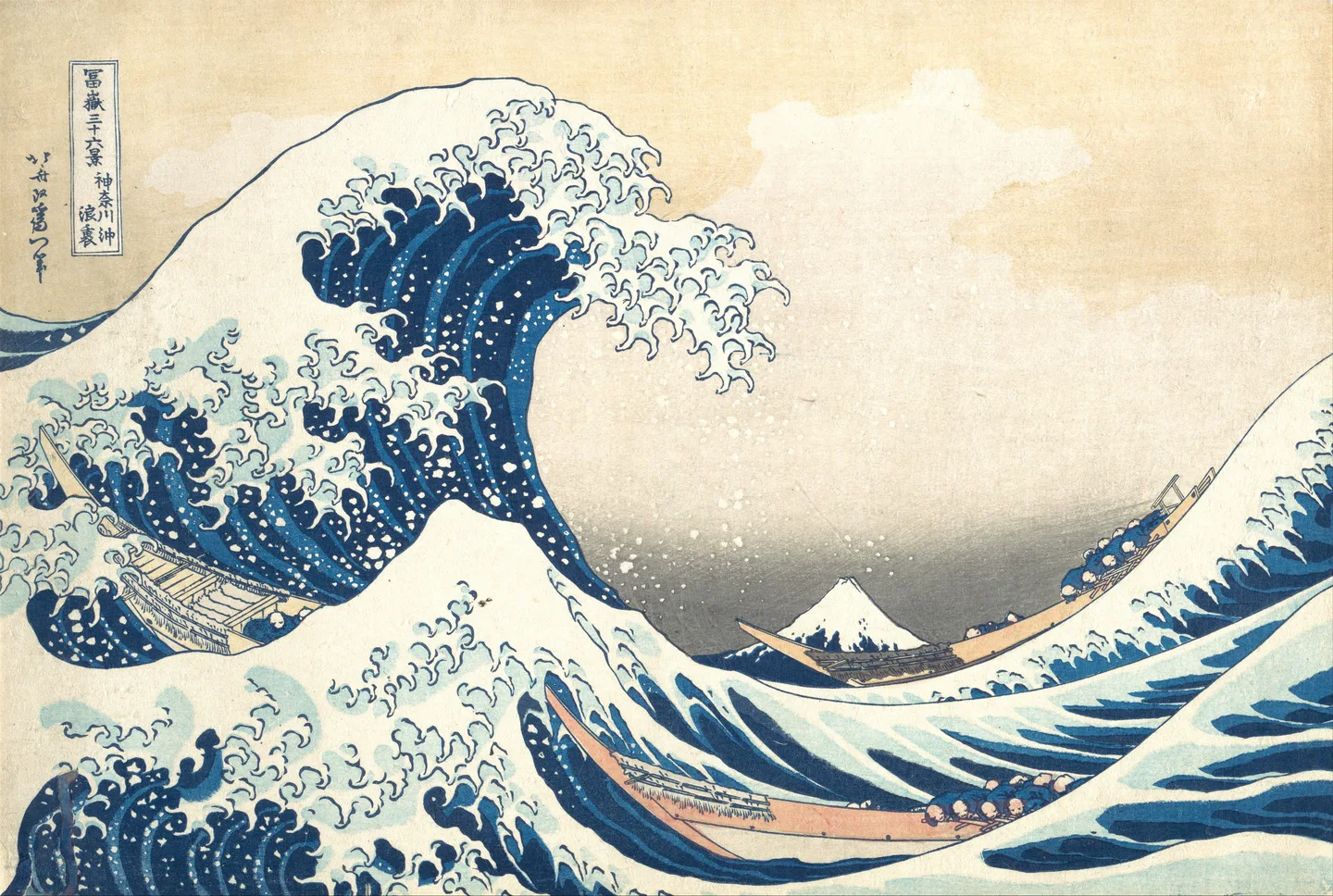
Ukiyo-e encompasses both painting and printmaking. Hokusai's Under the Wave off Kanagawa, the work widely called The Great Wave, is a multicolor woodblock print. Its waves, boats, and distant Mount Fuji appear in many impressions. A sheet in one collection can vary from another in color, printing quality, or condition. A specific impression's date and credit line belong to that object. The design traveled much farther than a single physical sheet could have done.
The guide to Japanese art movements traces later experiments that ask new questions about gesture, surface, and performance. In the twentieth century, painters also worked across categories often described as nihonga and yoga, drawing on varied materials and educational traditions. The categories have histories of their own and cannot be assigned solely from a Japanese subject or signature. When visiting the famous paintings collection, keep the medium, format, and artist attached to each title in your notes.
Frequently asked questions
How should I look at two screens displayed side by side online?
Check whether the museum identifies them as a pair and specifies right and left screens. Look for continuities in a horizon, branch, or pattern across the panels. Then examine each independently to see which relationships survive when the screens stand at different angles.
Is every image of Mount Fuji by Hokusai?
Many artists have represented Fuji from different places and in different media. A particular grouping of wave, working boats, and distant peak can identify Hokusai's design. The mountain alone identifies a subject, leaving the maker, series, and physical object to be established from other evidence.
Choose the viewing distance
Find one architectural partition in the Genji handscroll and one fold in Pine Trees. Which boundary belongs to the depicted room, and which belongs to the picture itself?