Japanese Art Movements
Japanese art movements: from ukiyo-e to Gutai and Superflat, with the visual clues that define each period.
The phrase Japanese art movement can refer to a print culture, an organized group with a manifesto, or a critical term proposed to connect contemporary images. Those are different historical things. The introduction to art movements gives a way to distinguish them. Ukiyo-e, the debates around nihonga and yoga, the Gutai Art Association, and Superflat each ask a viewer to look for a different relationship among maker, material, audience, and the institutions through which an image becomes visible.
Print and publishing culture — ukiyo-e
During the Edo period, images of actors, celebrated beauties, city life, landscapes, and other subjects circulated through paintings and commercially published prints. In the case of a multicolor woodblock print, a designer, block carvers, printers, and publisher could all contribute to the finished object. A series title, signature, publisher's mark, and censor seals can give historians evidence about production. A modern viewer needs a translation and a reliable catalog record to identify those marks accurately. The print exercise in the sample appreciation class compares what different impressions can preserve or lose.
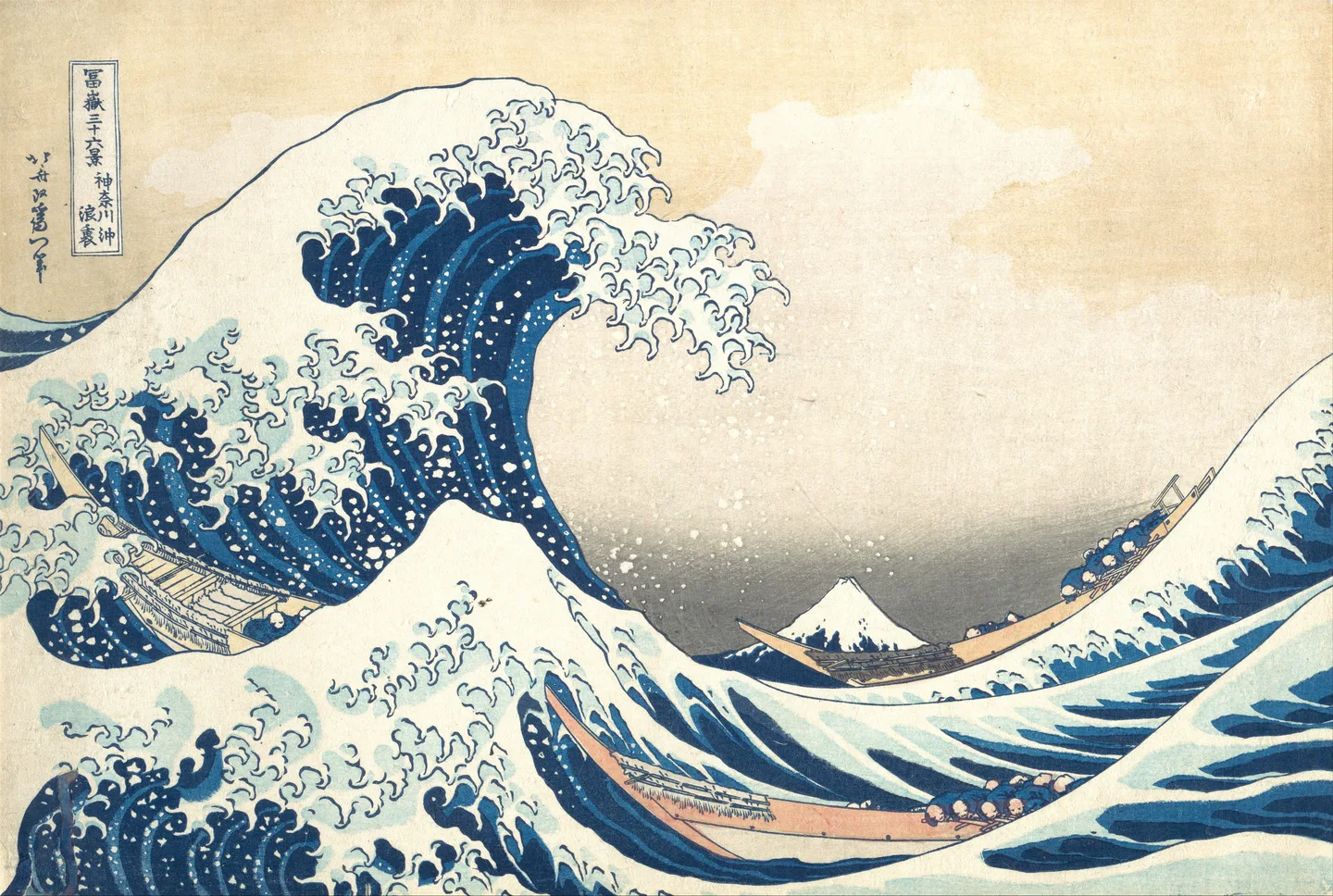
Hokusai's Under the Wave off Kanagawa provides a familiar example. White spray takes on the shape of small claws above boats carrying people through the wave. Fuji sits low and distant. A carving team had to translate such bold shapes and delicate lines into printable blocks. An impression in one museum might differ from another in the strength or placement of color. The Japanese painting and print guide compares this repeatable format with screens that change as a viewer walks across a room.
Modern teaching and exhibition categories — nihonga and yōga
During the Meiji era (1868–1912), artists and teachers debated how painting should be taught and exhibited in a rapidly changing Japan. The term yōga refers to Western-style painting in this context. Nihonga, or Japanese-style painting, developed as a modern category in the same debates. A historical ink painting may predate the exhibition category that a later catalog uses for it. Mount, pigments, training and display each tell a different part of that history. The modern labels make most sense when you know when they became available to the people using them.
Put the Met’s Mynah Birds Attacking an Owl, cataloged as “After Sesson Shūkei” and dated probably to the nineteenth century, beside Hokusai's Under the Wave. The mynahs approach from different sides. One turns its head toward the owl while another gives you a sideways profile. Imagine the same scene printed more than once from a set of blocks. The owl and its attackers would keep their outlines from impression to impression, although color and pressure could vary. In the painting, pools of dark ink and almost dry strokes can change within a single brush movement. Both works were made in Japan. The difference you can see is a decision about making and circulating an image.
An organized group — the Gutai Art Association
Founded in 1954 in the Kansai region under Jiro Yoshihara's leadership, the Gutai Art Association invited experiments with matter, gesture, space, and public events. Kazuo Shiraga worked paint with his feet and also performed an encounter with a mass of mud. In the latter case, resistance, weight, and the changing condition of the substance affected the result. A photograph may preserve a dramatic instant while concealing the duration of the action and the continuing alterations of the material.
Atsuko Tanaka's Electric Dress presented a body surrounded by a dense arrangement of colored electric lights. The Centre Pompidou identifies its garment as a reconstruction. A still photograph can convey its outline, but light, wiring, heat, and a human body occupying the structure give the work a different presence in an account of the performance. When a museum shows a reconstruction, check what was remade, by whom, and under what conditions. Painting, performance, and an object displayed in a gallery converge in Gutai's history without becoming interchangeable categories.
A critical and curatorial term — Superflat
Takashi Murakami introduced Superflat as a critical and curatorial concept around 2000. His character Mr. DOB makes the idea unusually easy to test. Look for a D on one round ear and a B on the other. The head between them supplies an O. Even when the face distorts or its teeth multiply, those three shapes can still work as a logo. A visitor might recognize the character first on a small commercial object and later on a gallery wall. The order matters. What looks like a brand borrowing the authority of a painting to one viewer can look like a painter borrowing the familiarity of a brand to another.
Compare this idea with the Op Art movement, in which a flat surface can generate a sensation of movement or curvature. The shared word flat would establish little on its own. For historical study, the art history guides supply other examples of movements defined by an institution, a shared manifesto, an exhibition, or a later historian's term.
Frequently asked questions
Was ukiyo-e a single group like Gutai?
Ukiyo-e names a broad tradition of pictures produced over a long period by many makers and publishers. Gutai was a particular postwar association with identifiable participants, exhibitions, and publications. Both terms have historical value, but they describe different levels of organization.
Does Superflat mean that every work literally has no depth?
The term addresses visual language and cultural hierarchies as well as appearance. Artists associated with it have produced sculptures and installations alongside images with sharply defined surfaces. Read the particular exhibition context and examine how the motif behaves in the actual medium you are viewing.
Read the label for the maker
Choose a Hokusai print and Tanaka’s Electric Dress. List the people or workshops credited in each record. For the dress, note when the version you can see was made.