Art Appreciation Class: What to Expect
What to expect in an art appreciation class: weekly themes, looking exercises, key terms, and how to get the most from discussions.
Follow one sample week in a discussion-based art appreciation class, from opening the assigned print at home to revising a paragraph after the meeting. Imagine the instructor projects Hokusai’s wave with the title covered. One student sees a threat to the boats. Another spots a mountain that hardly seems to move. Bring both observations to class and see how the group turns them into a question. The introduction to art appreciation explains the reasoning behind this exercise.
Before class, turn the assigned image into a question
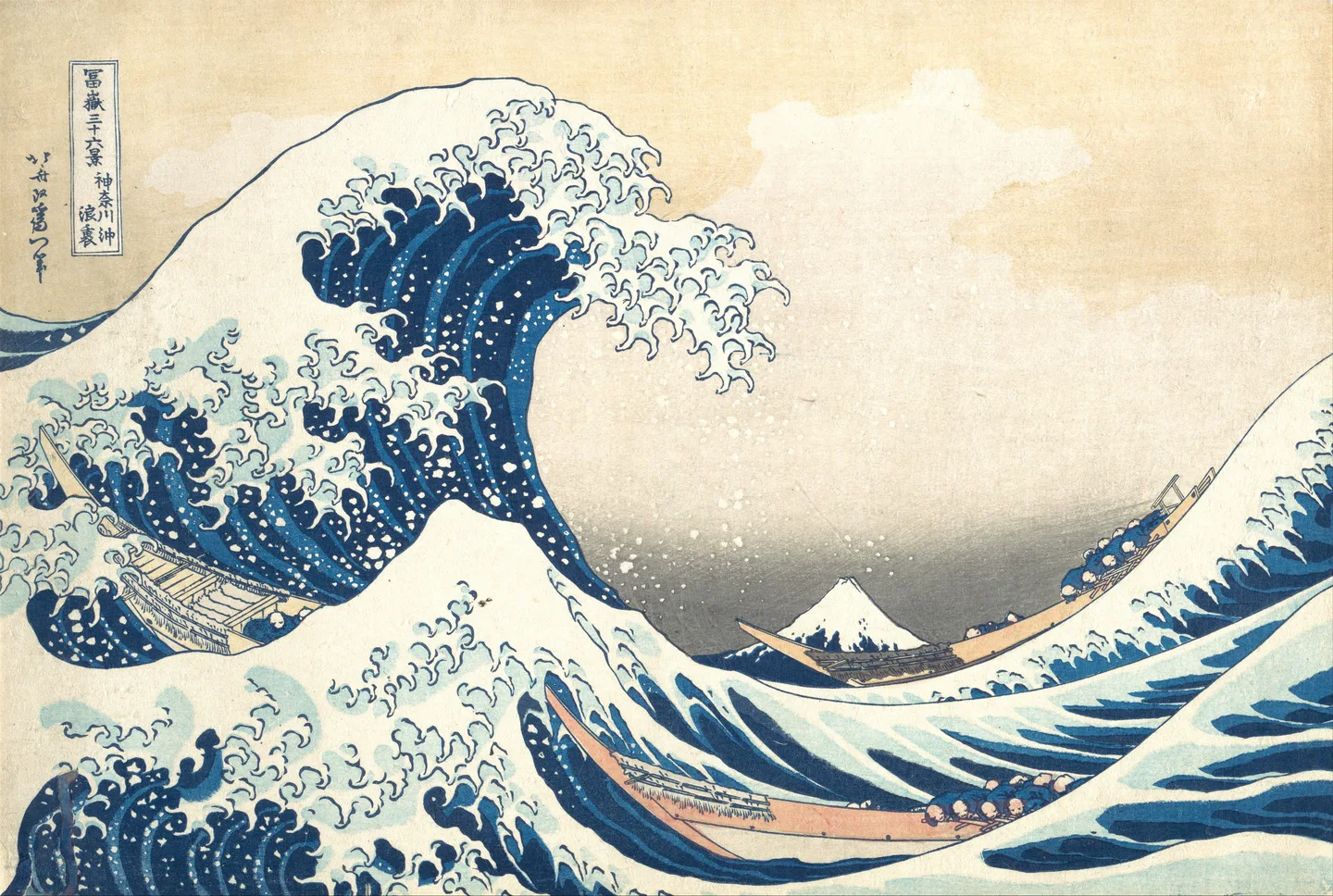
If the reading introduces line, shape, and texture, choose one assigned image and apply one of those terms to a particular area. Imagine your assignment features Hokusai's Under the Wave off Kanagawa in The Met’s collection. The large wave has white tips that divide into smaller points. Copy three of those points in the margin of your notes. Ask whether the shape occurs anywhere else in the print. You arrive with a question your classmates can actually investigate on the screen.
Check the medium while preparing. A woodblock print allows many impressions from the same set of blocks. Sheets may vary in color, condition, and printing. If a classmate describes a different blue from the one on your screen, compare the collection credits before disputing the observation. A week on printmaking may ask who designed, carved, printed, and published a sheet. The guide to Japanese painting and prints gives that conversation a starting point across several formats.
During discussion, make it easy for others to follow
Try this exchange in front of the print. One student says, “The mountain is about to be swallowed.” Another traces the unbroken strip of sky around Fuji's summit. Now the class has a better question. What makes two things appear so close together when the mountain must be miles behind the boats? The first student noticed a shape. The second noticed depth. The instructor can draw both observations on the board with the same two curved lines.
An instructor might put the wave beside a European seascape and ask for a comparison. Choose one question both images can answer. Where does each maker put the horizon? What size does a person occupy relative to the water? Give each work equal time before you name a difference. During a small-group exercise, one person can record observations while another checks that each phrase refers to a visible feature. Trade roles in the next round so both people practice the work of describing and checking. Try the same exchange with the two figures in the Art 100 comparison assignment. Record which detail your partner found first.
After class, turn a discussion into a short response
A two-hundred-word response on scale could open with a claim. “Hokusai makes Fuji look small enough to fit inside the wave, then gives us three boats by which to judge the wave's actual size.” The next sentence should say what the boats contribute. Riders crouch in long rows, each body a small unit against the curling water. If you removed them, the crest might look enormous or scarcely taller than a person. You have now supplied two linked observations that a reader can check without consulting a biography of Hokusai.
Keep a list of terms on the reverse side of your notes. Put an example beside each definition. For negative space, describe one bounded area of sky in the print. For contour, name the edge separating water from air. Before the next class, cover the image and recall a detail from its location alone. Try Artwork Memory's full-image and detail pairs as a short rehearsal for connecting an isolated feature to the work it belongs to.
How the same print serves three different weeks
An instructor can bring back the same sheet in a week on line, another on print technology, and a third on landscape. In the first, compare the white crest with Fuji's white summit. In the second, find two areas of blue that had to be printed in register with the outlines. In the third, ask why this scene of working boats belongs in a series about a mountain. Your old notes may become evidence for a new question, especially if they say where the details are.
Course names cover many formats. Some classes introduce architecture or design alongside painting. Others organize discussions around function, patronage, identity, or technology. The course-selection guide explains how to read a syllabus for those differences. For exercises you can do before the first meeting, browse the details and differences topic and choose a picture whose title you do not yet recognize.
Frequently asked questions
What should I say if somebody has already made my observation?
Locate a second detail that supports their point, or explain a place where their description becomes harder to sustain. In the wave print, a classmate might describe a threatening curve. You could point out how that same curve frames a small, apparently steady mountain and ask how it changes the effect.
Will I need to draw in a discussion-based class?
Some instructors use quick drawings to help students notice an angle, proportion, or repeated shape. Look at the assignment's criteria. A diagram intended to communicate the position of a horizon and three figures can work very well with a straight line and three dots.
Pack one observation card
On the front, sketch one forked tip of the wave and mark where Fuji sits. On the back, write a question a classmate can test. Add the museum and impression number so the two of you can open the same sheet.