Famous Paintings: The Complete Guide
Famous paintings: a complete guide to the works everyone should know, with what to look for and why they matter.
Famous paintings often reach us as tiny details first. A near touch between two fingers, the curl of a night sky, or a wave of raised hands can become more familiar than the complete work. Reattach those details to the objects that contain them and the pictures begin to ask better questions. The introduction to reading a painting gives a method for doing that. This guide approaches landmark paintings through four different things an image can do for a viewer.
Find a work by its viewing problem: The School of Athens and Travelers Among Mountains and Streams · Girl with a Pearl Earring and The Two Fridas · The Last Supper and the Migration Series · The Starry Night.
A painting can build a place for you to stand
Raphael's The School of Athens gives philosophers a grand architectural setting. Extend the lines of the pavement and vaults inward and the scene draws you toward its central figures. Groups on the steps conduct smaller arguments around that center. The building supplies a kind of intellectual order. An architectural shell that looks so convincing in reproduction is itself painted on a wall inside a Vatican room. The actual viewer enters one room and confronts another.
Now consider Fan Kuan's Travelers Among Mountains and Streams. A towering mountain occupies much of the vertical hanging scroll. Tiny travelers with pack animals appear far below it. You can move from detailed rocks and trees toward mist and a high cascade, discovering different scales along the way. The grand mountain does not require a single fixed place to stand in imagined space. The hanging scroll organizes a journey of attention across changes of texture, distance, and magnitude.
A painting can give you another person's company
Vermeer's Girl with a Pearl Earring turns toward us in a dark, shallow setting. The bright earring is suggested with remarkably economical reflected light. A parted mouth and backward turn leave room for the viewer to imagine an interrupted exchange. The work is generally discussed as a tronie, a study of a character or head in distinctive costume. The desire to know a sitter's biography is understandable, but this category asks us to notice what expression and costume can do independently of a documented identity.
Frida Kahlo's The Two Fridas places two versions of the artist shoulder to shoulder. They hold hands, share a physical resemblance, and wear markedly different clothes. Visible hearts and a connecting blood vessel complicate the conventional dignity of a formal seated portrait. Both bodies face the viewer, yet the linked hands direct attention across the painting. Compare how a single turning head and a doubled frontal figure create different relations with an observer who enters the gallery alone.
A painting can gather several moments together
In Leonardo's The Last Supper, reactions unfold across a long table. Groups of hands reach, withdraw, open, and point. While the scene gathers around Christ's announcement, looking at the wall painting takes time. A viewer can follow one apostle, then another, as if testing different consequences of a single sentence. Seeing a photograph of the room helps explain how the painted architecture extends the space of a religious dining hall.
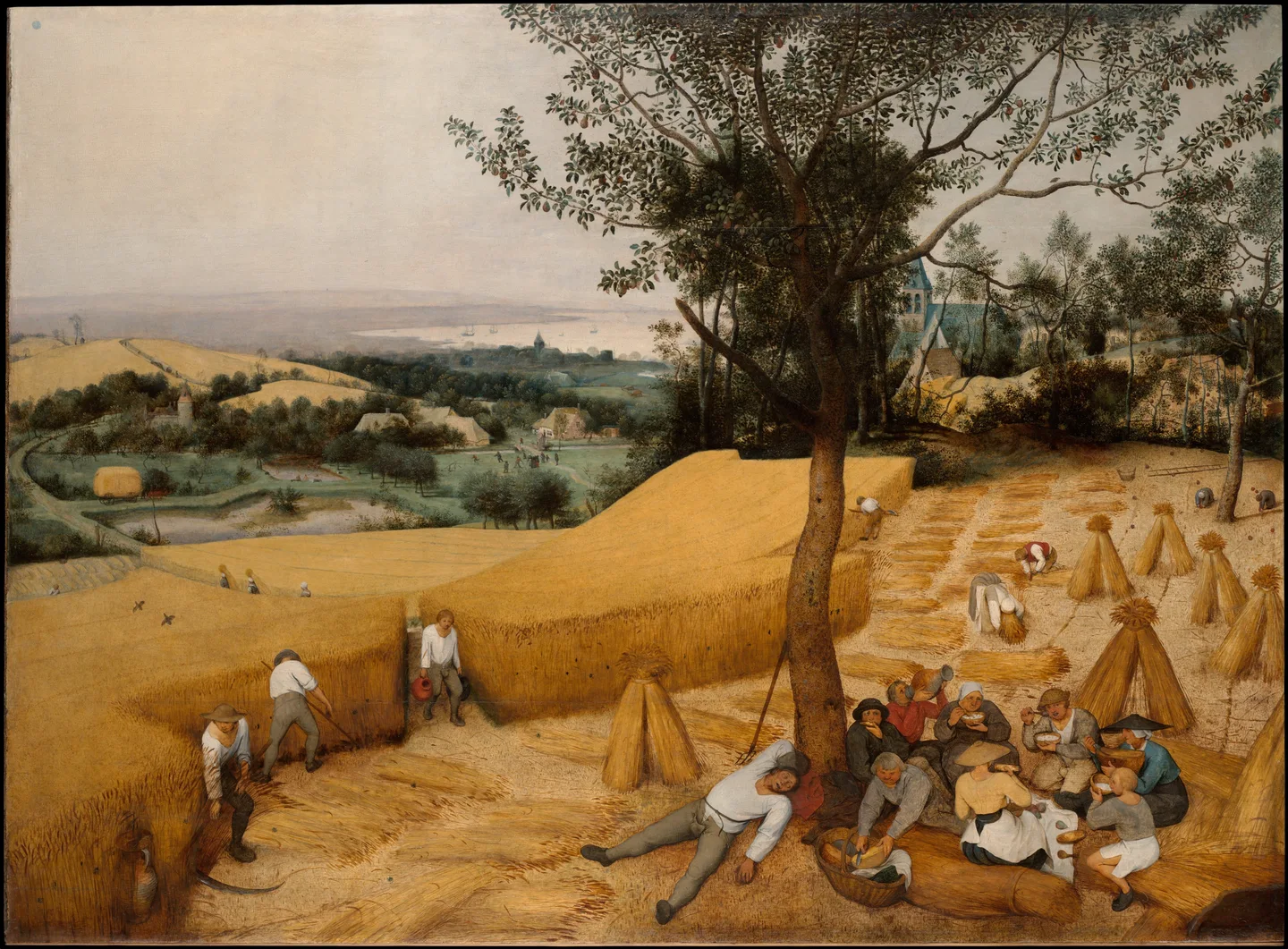
The modern painting guide tests what happens when a viewer follows a line across a single picture. A different kind of time appears in Jacob Lawrence's Migration Series. Sixty panels, paired with captions, follow the movement of African Americans from the rural South toward northern cities. No isolated panel has to carry the entire historical account. A railway station, a family grouping, or a line of travelers gains force through recurrence across successive panels. If a museum displays only part of the series, check which panels precede or follow a particular scene and how a caption shifts your understanding of the painted action. Try the same test of time in Bruegel’s The Harvesters. The meal beneath the tree happens while the workers to its left cut grain. Describe both actions in a single sentence, then decide which one you had to notice first to make sense of the other.
A painting can change what counts as a memorable detail
A detail need not identify a named character. In Van Gogh's The Starry Night, the dark cypress rises across the division between land and sky. Cropped out of the painting, a few upward flames of foliage might resemble the twists in the sky. Return the crop to its position and the tree becomes a link between the earth below and the great movement above. Try Match the Detail and see which fragments carry enough information to place them accurately.
When exploring paintings by individual artists, choose one detail that most reproductions preserve and another likely to disappear. A face may survive on a postcard, while the difference between matte and glossy paint will be much harder to see. That distinction matters especially for a picture with a large reputation. The account of why the Mona Lisa became famous follows an object that people can identify in simplified outline although much of its effect depends on gradual, delicate transitions. More case studies appear in the famous paintings collection.
Frequently asked questions
Which famous painting should I study first?
Pick one whose image you recognize but whose physical format surprises you. Look up its dimensions and discover whether it is a portable panel, an enormous canvas, a wall painting, or one sheet from a series. The change in scale or format gives you a concrete reason to look again.
Does an image need to represent its entire culture to count as famous?
An image can circulate extensively for reasons connected with collecting, schooling, reproduction, or a particular historical event. Its visibility tells you something about those routes of circulation. Explore less frequently reproduced objects from the same place and time to see which subjects and techniques the familiar image leaves out.
Put a detail back in its setting
Cover the cypress in The Starry Night, then uncover it. Which part of the sky now seems connected to the village?