Famous Paintings of Famous Painters
Famous paintings of famous painters: a visual list of landmark works by Leonardo, Van Gogh, Monet, Picasso, and more.
A list of famous paintings of famous painters can connect a name with a picture very quickly. The more interesting task is connecting each name with a choice you can actually see. This companion to the guide to famous paintings pairs recognizable makers with decisions about edges, scale, color, or viewpoint. Save an example that complicates your idea of an artist. A career has room for both a signature solution and the moment its maker tried something quite different.
Leonardo and Michelangelo make a figure turn
Look first at the direction of the shoulders. Does the turn lead to someone inside the picture or to an unseen presence beyond it?
Leonardo da Vinci, Lady with an Ermine. Draw an arrow across the sitter’s shoulders, then another along her line of sight. They point in different directions. The white animal turns its head to the same side as the woman, so even a viewer who knows nothing about the sitter can sense a shared object of attention outside the frame. Cover the animal’s head with your thumb. Much of the suggestion that someone has just entered the room disappears. Leonardo gives the turning animal a job that a decorative accessory could hardly do.
Michelangelo, Doni Tondo. In this circular panel the Virgin twists from the waist and raises both arms toward the child held between her and Joseph. Follow the route from her knees through her shoulders to her hands. Even on a flat surface you can imagine how far one part of the body has rotated relative to the next. Set that movement beside Leonardo’s portrait. In one work a turn connects people inside the frame; in the other it points to a presence outside it.
Monet and Van Gogh solve different problems with color
Test the same patch of warm color twice. Does it open a route into a harbor or hold a piece of furniture in place?
Claude Monet, Impression, Sunrise. The orange sun appears unusually distinct against blue-gray air despite occupying little space. Dark boats establish layers in the harbor without requiring a detailed drawing of every vessel. Look for the upright marks in the distance and the short strokes on the water. One set helps locate the industrial port, while the other gives a viewer a shifting surface through which the orange reflection can travel.
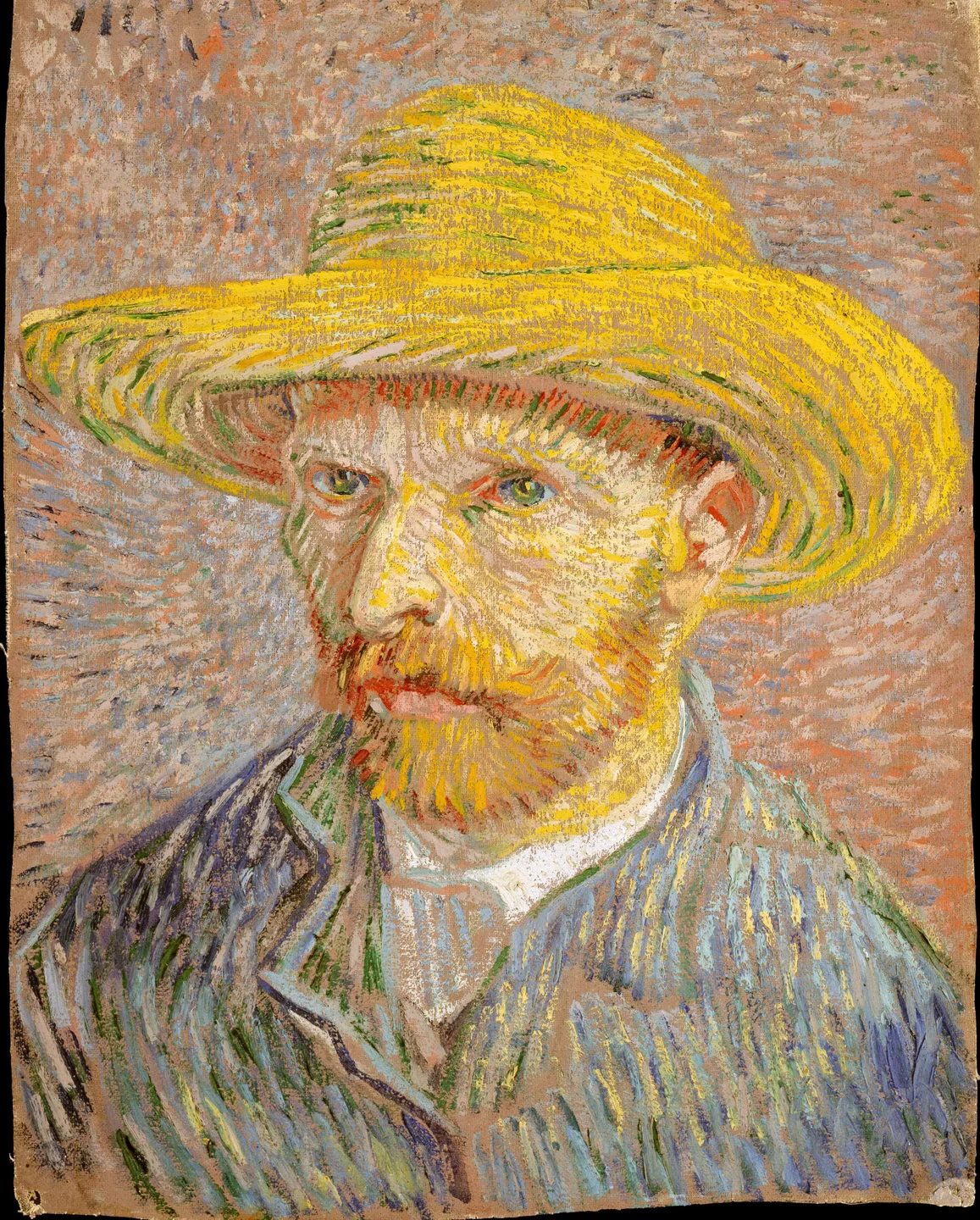
Vincent van Gogh, The Bedroom. A bed, two chairs, a table, and pictures on a wall occupy a room whose perspective can feel disconcertingly tilted. Colored outlines give the furnishings a distinct presence. Several painted versions exist, so check the collection before comparing colors or wall decorations. Even in a small reproduction, the shape of the far wall and the strong receding edge of the bed give the room an identity that a photograph of the actual furniture would struggle to reproduce. Try the same exercise with Van Gogh’s Self-Portrait with a Straw Hat. Pick a short patch from the hat and another from the coat. In which direction do the strokes keep the colors apart?
Picasso and Kahlo rearrange the body
Follow the edge of a sleeve. Where can you complete the arm beneath it, and where does its outline lead into another shape?
Pablo Picasso, Three Musicians. In the version at the Museum of Modern Art, a clarinet, a guitar, and a sheet of music give you a route through the three seated figures. Start at the guitar and try following the player’s arm. An edge that first looked like the side of a sleeve can suddenly read as the boundary of a patch of color. The shapes have the sharp edges of cut paper, although the picture is oil on canvas. Remembering the instrument together with that small puzzle about materials is more useful than trying to identify Picasso by angularity alone.
Frida Kahlo, Self-Portrait with Cropped Hair. Kahlo sits with scissors in her hand. Cut strands cover the floor and her loose suit disrupts expectations established by other self-portraits in elaborate dress. Her face turns outward, while the aftermath of an action lies scattered around her. Compare the suit's large, quiet areas with the fine lines made by individual locks. A change of scale between two kinds of marks can shape a story before a viewer has deciphered the words above her.
Cassatt, Hokusai, and the frame
Cover the margins with your hands. Which parts of the boat and the mountain need the edge of the image to establish their scale?
Mary Cassatt, The Boating Party. A darkly dressed rower dominates the near side of the boat, while a woman with a child faces him across the narrow space. A strong diagonal oar cuts between the figures. Identify what the frame removes at its edges and what it pushes close to the viewer. You can reconstruct the sense of being inside the boat even though the picture gives relatively little information about where the boat is going.
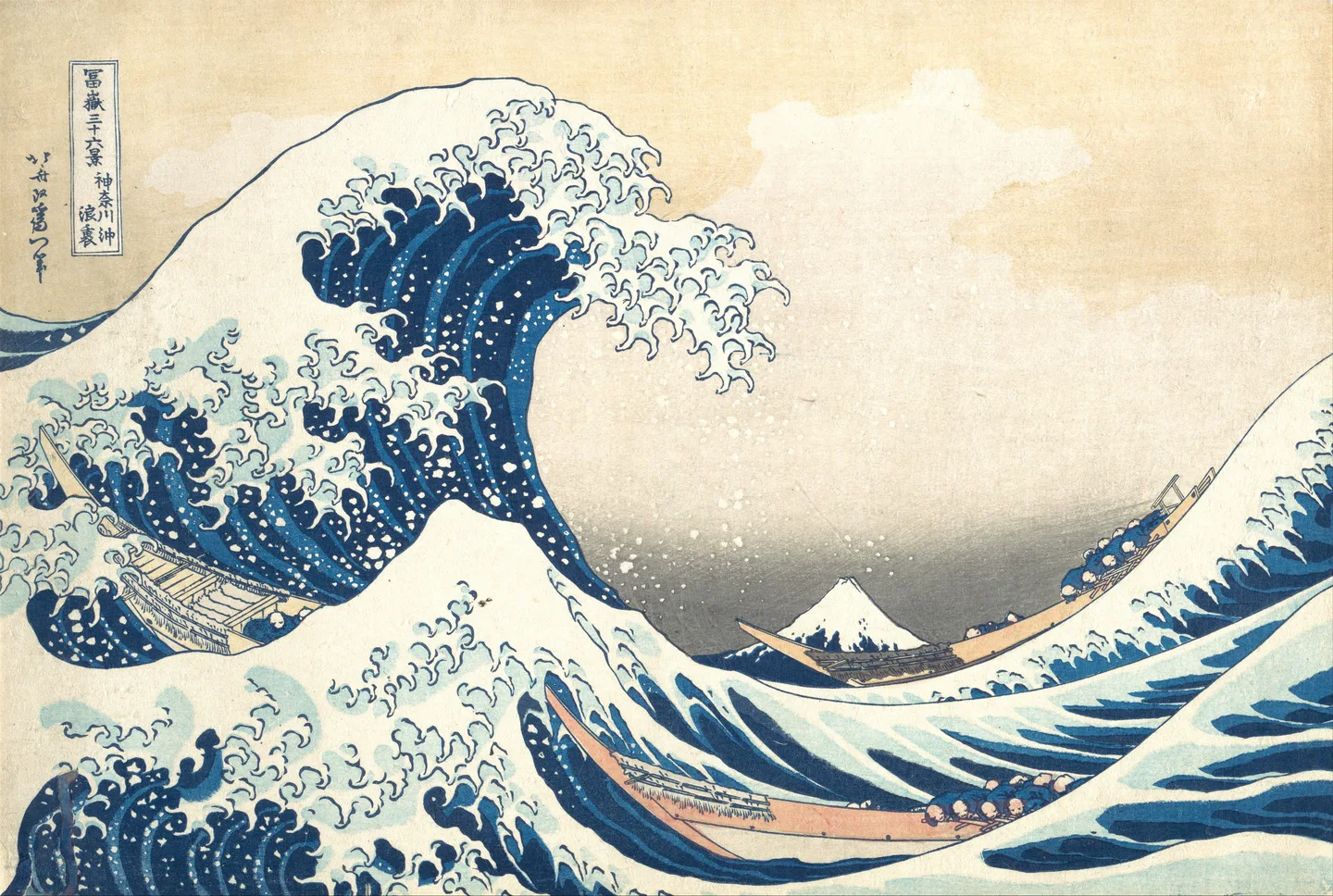
Katsushika Hokusai, Red Fuji. The mountain rises as a great colored slope beneath patterned clouds. This work is a woodblock print, providing a useful comparison with painters who also shape images through broad areas of color. Successive impressions preserve the design while varying in appearance. For another exercise in recognition, match an isolated detail to its full composition and identify the line or boundary that helped you decide.
The hundred-work index expands the selection across more makers and periods. Try comparing two makers whose subjects overlap, and then revisit the famous paintings topic to find a closer study of one work.
Frequently asked questions
What is the quickest way to remember which artist made which painting?
Associate the title with an action the artist took. Leonardo aligned a sitter’s gaze with the turn of an animal’s head. Cassatt placed a rower close enough to cut across a scene. An association with a specific decision survives better than a general word such as expressive. The painter identification quiz tests that distinction.
Should a print be included when studying painters?
A print makes an especially productive comparison when it shares a visual problem with a painting. Keep the medium in the identification and ask what had to happen for this particular image to reach paper. Hokusai's division of a mountain into broad colored shapes makes the distinction concrete.
Compare two turns
Sketch the sitter’s line of sight in Lady with an Ermine and the path of the child in the Doni Tondo. Which turn carries your eye outside the frame?