Guess the Painter Quiz: Tips & Examples
Guess the painter quiz: tips for recognizing brushwork, color, and subjects, with examples from famous artists.
A guess the painter quiz asks who made an image. That sounds similar to naming its subject, yet the person depicted, the person who commissioned the work, and the person who painted it can all have different names. Start by learning how to read a painted surface for information about line, color, handling, and scale. Then try the six practice cases below. Each gives two plausible names and enough information to support a choice without relying on a mysterious personal instinct for style.
Three cases about brushwork and color
- You see a postman in a dark blue uniform against a strongly patterned background. Short, directional marks animate the face and beard, and complementary colors intensify their outlines. Does this particular description point toward Vincent van Gogh or Claude Monet? Name a clue other than vivid color.
- The iron ribs of a station roof descend toward the tracks. Steam dissolves parts of the engines and the expensive new architecture around them. Which painter produced a group of these Saint-Lazare station canvases, Gustave Caillebotte or Claude Monet? Both depicted modern Paris near the railways, so “a train” is insufficient evidence.
- A riverbank scene places carefully spaced people in profile under trees. A woman at the right holds a monkey on a lead. In a detail you can distinguish numerous small touches of contrasting color. Who painted it, Paul Signac or Georges Seurat? Which detail clinches the choice more securely than divided color?
Three cases about subjects and structure
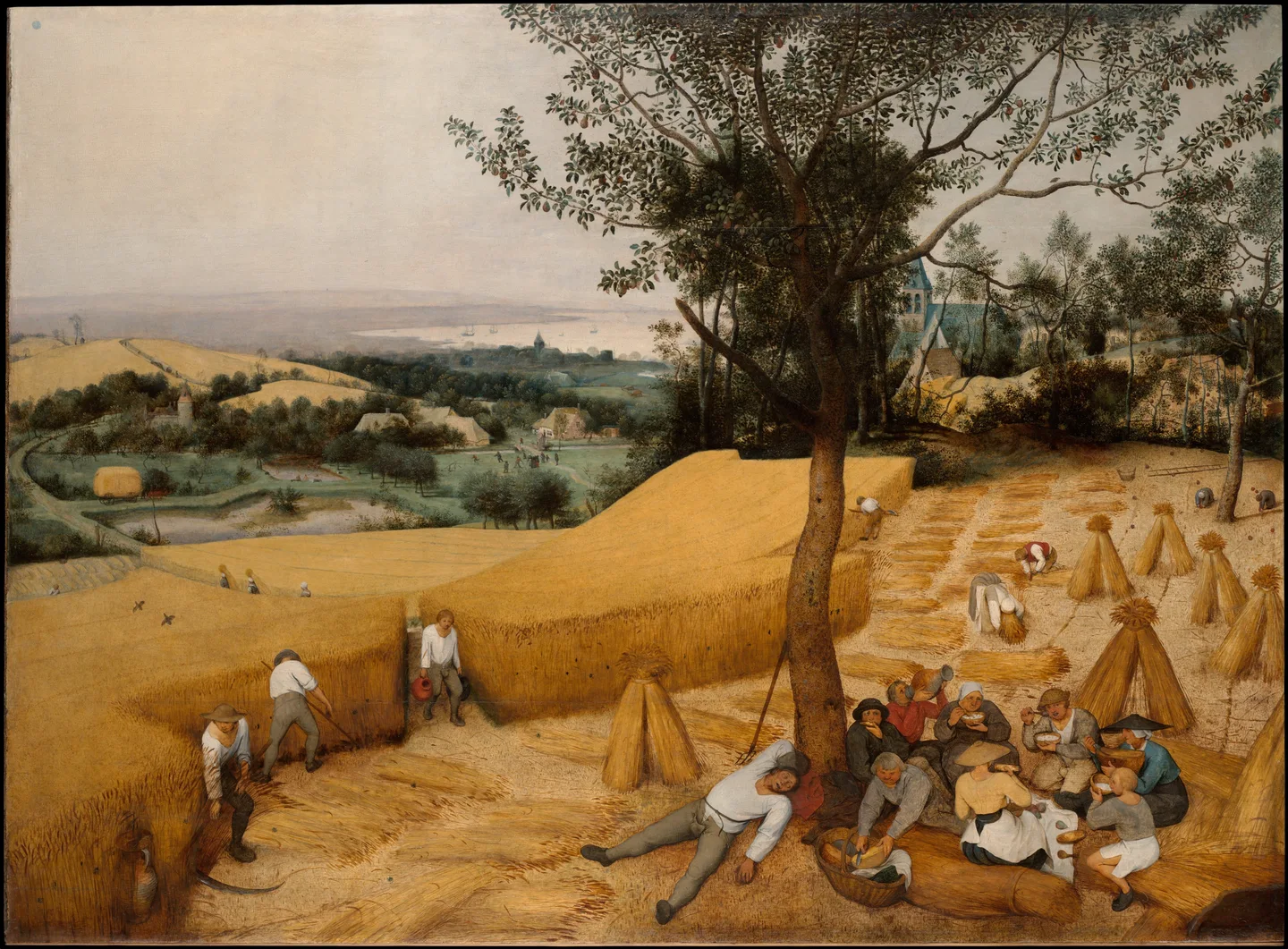
- Read this harvest scene for two different kinds of activity. People sit under a tree at the right while laborers cut the tall yellow grain. A broad landscape recedes toward water. Which artist painted it, Pieter Bruegel the Elder or Jean-François Millet? Both ask the viewer to attend to labor in a field.
- A procession of powerful horses and handlers moves across a large horizontal canvas. The painter studied the Paris horse market, and the painting is known as The Horse Fair. Choose between Rosa Bonheur and George Stubbs, both celebrated for depicting animals.
- A man in a white collar faces the viewer, his dark coat set against a plain ground. The title gives his name as Juan de Pareja. He was a painter himself. Was this particular canvas a self-portrait by Pareja or a portrait by Diego Velázquez? Which part of that question cannot be settled from his coat or his expression?
Key to the brushwork cases
- Vincent van Gogh. Joseph Roulin, the Arles postman, sat for several portraits. Follow the coils of the beard in MoMA’s Portrait of Joseph Roulin, then check the maker field. The curves helped you find the canvas. The record supplies Vincent van Gogh’s name and distinguishes this version from other sittings. His clothing and beard provide clues independent of the painter's directional marks. Different paintings of the same sitter can have different backgrounds. Compare several famous Van Gogh paintings before treating any particular wallpaper pattern as a signature of the artist.
- Claude Monet. In the National Gallery’s 1877 station painting, Monet sets vapor against iron and glass. Caillebotte's Le Pont de l'Europe gives the viewer a position on the bridge near the station, with the heavy diagonal girders dominating the walk. To distinguish two painters of a modern railway district, it helps to specify exactly where each placed the observer.
- Georges Seurat. The leashed monkey at the right helps identify A Sunday on La Grande Jatte. Signac also worked with divided touches of color and painted people by the water. Those clues alone leave a serious rival. A monkey beside the tall woman with the parasol narrows the problem to a particular large canvas in Chicago.
Key to the structure cases
- Pieter Bruegel the Elder. In The Harvesters, eating, sleeping, cutting, and carrying continue in different parts of the same broad view. In Millet's The Gleaners, three large bent bodies organize the foreground while much of the wider harvest recedes. Ask how the picture distributes work through space. The guess the painting examples apply that choice to titles.
- Rosa Bonheur. The Horse Fair shows the rhythm of a whole group being managed in motion. Stubbs also studied the anatomy of horses closely. A convincing depiction of musculature is therefore a weak clue for choosing between them, whereas the location, format, and action together identify Bonheur's work.
- Diego Velázquez. He painted Juan de Pareja in Rome in 1650. The title names a sitter who also made paintings, an especially good reason to consult the maker field separately. The collar can identify this composition once you know it, while authorship needs the object record. Who's in the Painting? asks the complementary question, whose face have you just seen?
At the end, underline the clues that would still work if the image were displayed in grayscale. A distinctive shape, way of placing the viewer, or combination of subjects might survive the change. Evidence involving color harmony would disappear. The visual memory guides offer another way to investigate which elements identify a sitter and which belong to a painter's choices.
Frequently asked questions
Can brushwork settle an attribution by itself?
In a practice quiz, distinctive handling can guide a choice between known options. Museum attributions can also depend on provenance, technical examination, documents, and comparison with securely attributed works. A digital reproduction may hide the scale and texture needed for even a preliminary brushwork comparison.
How should I study an artist who changed style over time?
Build pairs from different stages, label each with its date, and find something concrete to describe in each. A painter may change palette, materials, collaborators, or subjects. A chronological set gives you a way to recognize those changes without forcing a whole career into one visual formula.
Repeat a case without its colors
Pick the Roulin or Seurat case. Cover the color words in your clue and try again. Record the shape or placement that survives, then copy the artist’s name from the museum record to check your choice.