Why the Mona Lisa Is Famous
Why is the Mona Lisa famous? Discover the painting's history, technique, theft, and the details that made it iconic.
To understand why the Mona Lisa is famous, put two pictures side by side in your mind. One is a small oil painting on a poplar panel, showing a seated woman with her hands folded. The other is an image that has appeared on newspaper pages, posters, souvenirs, and countless parodies. The guide to famous paintings considers how a detail can travel beyond its original setting. Leonardo's portrait acquired its extraordinary audience through a combination of painting technique, collecting, criticism, theft, and reproduction.
Start with the hands and work upward
The hands rest one over the other near the lower edge of the picture. Their overlap describes a stable seated pose. Follow the forearms toward the shoulders, then compare the direction of the torso with the head. The modest turn gives the figure a sense of attending to somebody who has just entered her space. Her body and gaze establish an encounter before the viewer even begins to consider the much discussed expression around the mouth.
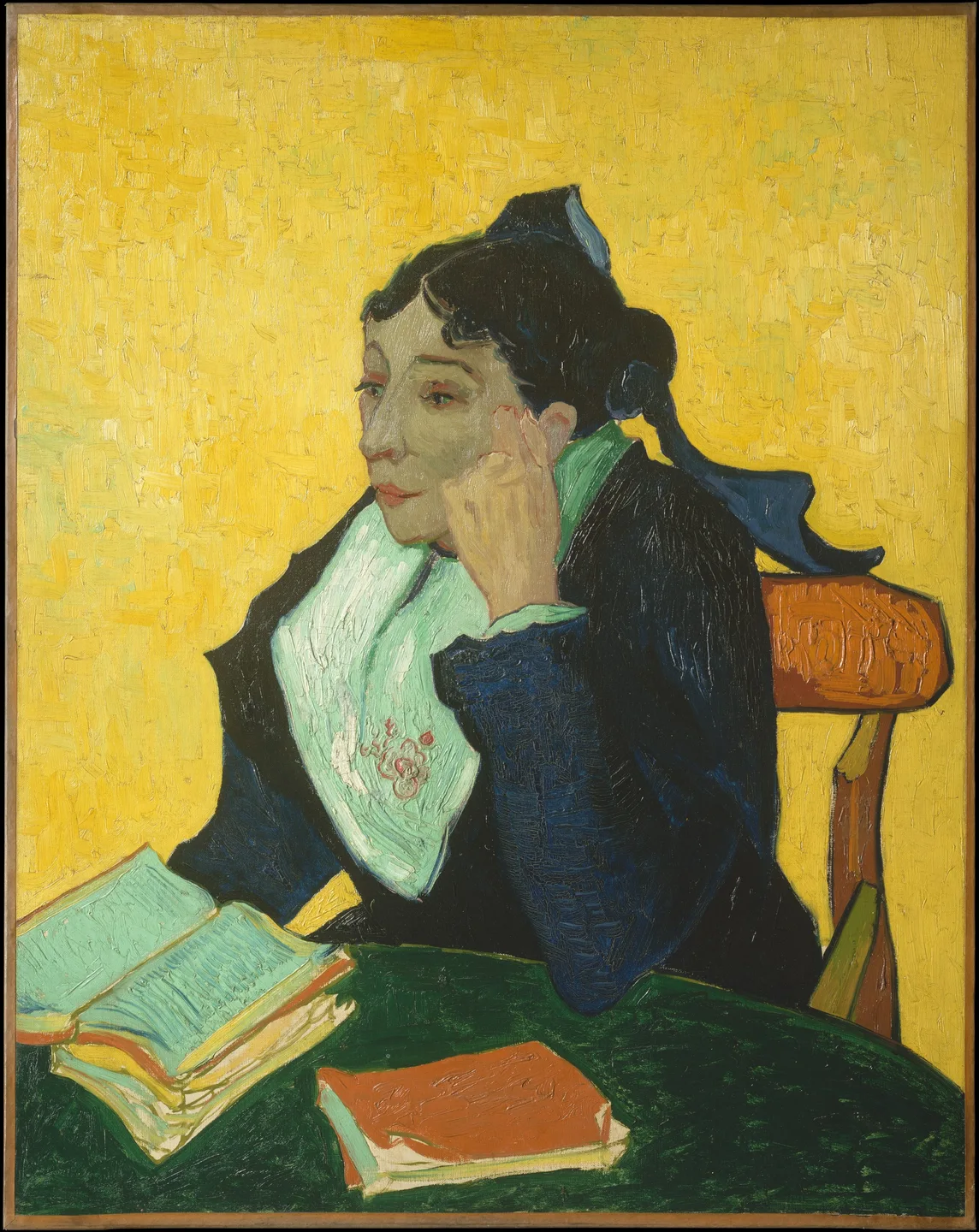
Leonardo softened the transitions between lit and shaded parts of the face. This approach is often called sfumato, a word associated with smoke. Look at the corners of the mouth beside the more definite boundaries of the garments. A reproduction with its contrast pushed up may make those gradual changes much less subtle. Instead of asking whether she is smiling, describe which edges are sharp enough to locate with a pencil and which ones lose themselves in the surrounding skin. In the comparison portrait, Van Gogh’s Madame Ginoux rests a hand against her cheek. Follow her bent arm back toward the face, then look again at how Leonardo brings your eye up to his sitter’s expression without either hand touching it.
Put the sitter back into a landscape
Behind the figure, paths and waterways thread through a terrain of rocks and distant hills. Atmospheric changes of color and contrast give distance to a space that no chair or table could establish on its own. The figure interrupts our access to that view. We can look out on either side of her, but the central route into the country beyond is occupied by a person looking back. It is an unusual balance of intimacy and remoteness.
The sitter is generally identified as Lisa Gherardini, the wife of Florentine merchant Francesco del Giocondo, hence the Italian title La Gioconda. Leonardo began the portrait in the early sixteenth century and continued working on it over time. The small panel later entered the French royal collection. Comparing it with other Renaissance paintings puts the three-quarter pose, worked landscape, and subtle modeling beside different solutions available to artists and patrons in the same broad period. Set the distant blue slopes beside the harbor haze in Monet’s Impression, Sunrise. Which distances can you still judge if you cover the horizon?
Trace a reputation that already existed before the theft
The Louvre’s history of the Salle des États traces royal interest in the painting to François I, who acquired it in 1518. The royal collections went on public display at the Louvre after the French Revolution. Long before the theft, visitors could stand before a painting already admired at the French court. Readers could carry an imagined Mona Lisa with them before encountering the physical panel. Accounts of mystery can shape what a visitor expects to find. Try describing the mouth and eyes without using the words mysterious or enigmatic and notice how much more closely you need to look.
On 21 August 1911 the painting disappeared from the Louvre. News of the loss spread rapidly and rewards were offered. The museum recounts that more than two years later Vincenzo Peruggia, a former worker at the Louvre, tried to sell the panel to an Italian art dealer. The dealer alerted the authorities. The incident expanded an existing reputation into international news. It also gave newspaper editors a reason to publish the same identifying image repeatedly, including for readers who might never set foot in the museum.
Watch a small panel become a public image
In 1919 Marcel Duchamp added a mustache and goatee to a reproduction for his work L.H.O.O.Q. A joke of that kind depends on the audience immediately recognizing the source. It also turns recognition itself into part of the subject. The Dada movement guide explores why an artist might alter a mass-produced image and what changes when that intervention enters a collection in its own right.
When you try Match the Detail, think about which fragments could identify a painting from its composition and which require prior familiarity. A small section of hands might communicate a pose without identifying its maker. A crop of the mouth can carry a whole public reputation. Return to the complete portrait after looking at a few reproductions and locate something the familiar crop leaves out, such as a road or a fold of fabric. Other works in the famous paintings topic have taken very different routes toward recognition.
Frequently asked questions
What detail disappears if a reproduction shows only the face?
The overlap of the hands establishes how the sitter is turned. Look for the forearm resting on the chair, then widen your view until you can see a sliver of the chair itself. Those details give the face a seated body and a distance from the viewer.
Why does it seem smaller in the museum than in photographs?
The panel measures 79.4 by 53.4 centimeters according to the Louvre’s current collection record. A photograph can enlarge the face to fill a screen or a printed spread without including a human figure for scale. Museum barriers, the surrounding architecture, and the distance from the actual panel also shape a visitor's sense of its size.
Look past the familiar crop
Start with the mouth, then widen the view until both hands and one distant road appear. Which change most alters your sense of the sitter’s pose?