Art History Quiz Questions (With Answers)
Art history quiz questions with answers: practice identifying works, artists, periods, and details before your next test.
These art history quiz questions are a rehearsal for identifying an unfamiliar image under exam conditions. Each prompt describes a visual situation. Choose the more defensible answer and record a clue that rules out the alternative. The general art history quiz mixes periods and facts, while this set concentrates on making a decision from the description in front of you. Try a warm-up before the eight questions. Suppose your alternatives are a woven tapestry and an oil painting on canvas. “Made on fabric” fits both. “The colored threads themselves form the design” supports the tapestry. In pairs, have one person propose a clue and the other test it against the rival answer.
Identify the image from its construction
- An Italian wall painting seems to open into a chapel. A crucified figure stands directly on the axis of a deep coffered vault, two donors kneel near the front, and a skeleton lies below. Is this Masaccio's Holy Trinity or his Tribute Money? Which detail places the painting in the setting of a memorial?
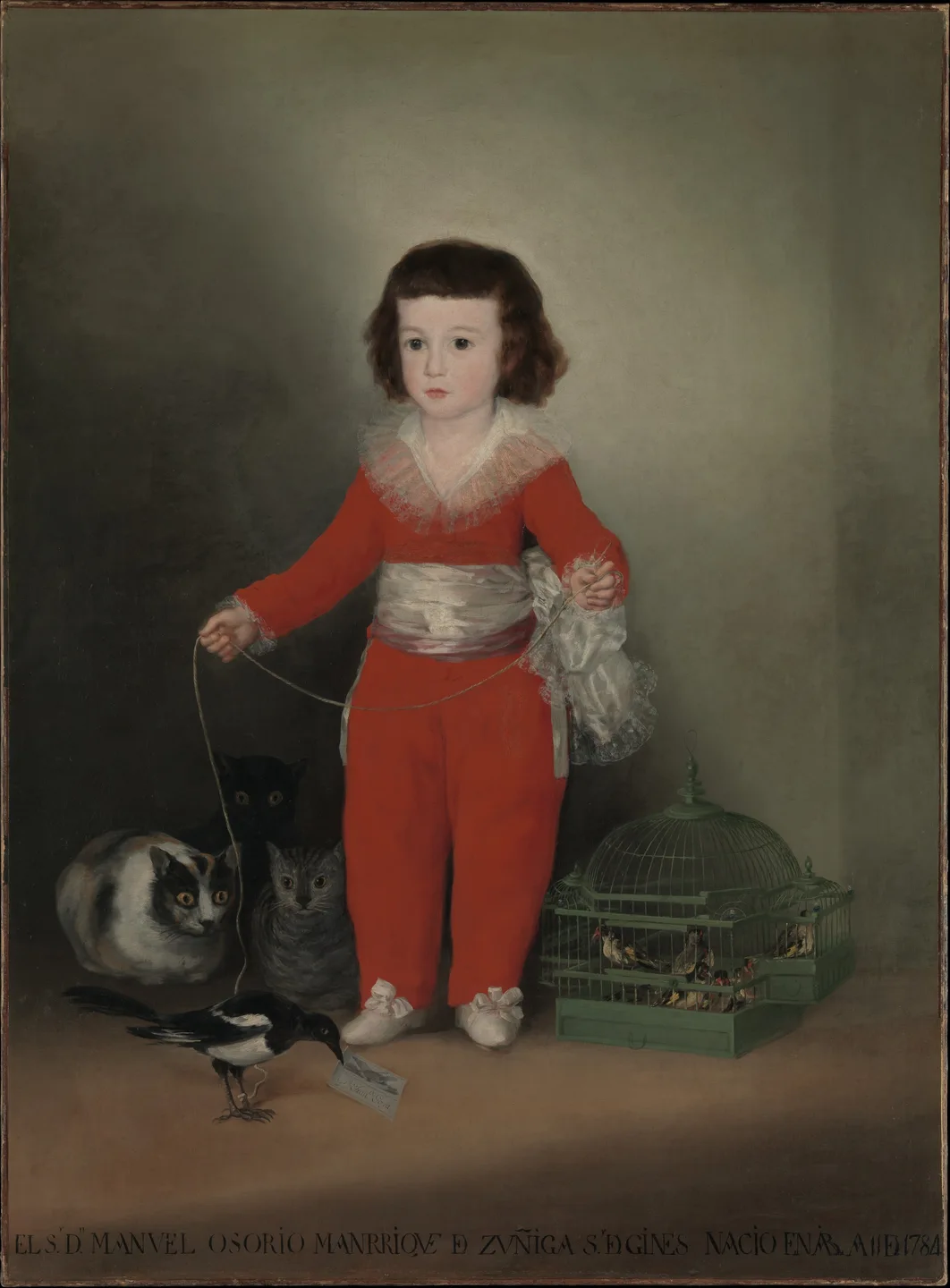
- A boy wears a bright red outfit. One hand holds a string tied to a magpie. Behind it, cats look toward the bird. Is the painting Goya's portrait of Manuel Osorio Manrique de Zuñiga or Velázquez's Juan de Pareja? Which apparently minor detail provides a second clue to the painter's identity?
- Through broad glass windows you see a counter, a server in white, and a few late-night customers. Is this Edward Hopper's Nighthawks or his Automat? In both works a city interior is still open after dark. Decide where the painter has placed the viewer in relation to the glass.
- A painted interior contains a large canvas seen from behind, a child surrounded by attendants, and a mirror at the far end of the room. Decide between Velázquez's Las Meninas and Jan van Eyck's Arnolfini Portrait. Both paintings famously include a mirror.
Identify the decision the artist has made
- A painter represents the same saint at several different points in one continuous landscape. Is the more precise formal term continuous narrative or linear perspective? Explain whether your answer describes the organization of time or of space.
- A main figure appears larger than surrounding attendants, although everyone stands on approximately the same ground line. Which possibility should you investigate first, hierarchical scale or atmospheric perspective? The scene is ceremonial and the main figure wears a crown.
- Blue hills in the distance have softer edges and weaker contrasts than branches near the viewer. Does this example demonstrate atmospheric perspective or the use of a vanishing point? Both devices can communicate depth.
- A small painted strip below a larger altarpiece contains several scenes from a saint's life. Which term identifies the location, predella or pediment? Picture the architecture or furniture to which each word belongs.
Explanations for the four identifications
- Masaccio's Holy Trinity, an Early Renaissance fresco. Santa Maria Novella’s account of the fresco locates the tomb. The skeleton below the donors makes the encounter with death explicit. Tribute Money also uses convincing space, and Masaccio painted both, so the maker and period alone cannot decide the question. In Tribute Money, Peter appears more than once in a continuous landscape as the story moves from request to payment.
- Goya's Manuel Osorio Manrique de Zuñiga. In The Met’s portrait of Manuel Osorio, the magpie has picked up a card bearing Goya’s name. Enlarge the card where a reproduction permits. The cats' attention to the bird makes it easy to overlook this tiny piece of authorship evidence. Velázquez's Juan de Pareja shows an adult man against a restrained background, with no leash, bird, or watching cats.
- Nighthawks. In Chicago’s Nighthawks, you are outside the diner looking in. In Automat, you share the interior with a seated woman, and a dark window stands behind her, reflecting rows of lights. That reversal of the viewing position distinguishes the two more reliably than loneliness or nighttime. Try Name That Painting with a room you can locate before you can name its occupants.
- Las Meninas. The back of a large canvas and the child with attendants distinguish the Spanish court scene. In the National Gallery’s Arnolfini Portrait, the small convex mirror sits behind a pair of standing figures. In both works a mirror raises questions about what lies beyond the space we can see directly.
Explanations for the four terms
- Continuous narrative. One setting can contain events separated in time. Look for repeated costume, attributes, or actions to establish that multiple figures represent the same person. Perspective concerns the depiction of spatial relations and may occur within the very same picture.
- Hierarchical scale. Differences in social, religious, or narrative importance can organize the sizes of bodies. Check the image's context before reaching a firm conclusion. The term describes a convention, while the crown and ceremonial arrangement supply supporting evidence for this example.
- Atmospheric perspective. Diminished contrast and less distinct edges suggest the effect of air over distance. A vanishing point describes a geometrical relation among receding lines. The guide to famous landscape paintings offers examples for observing how painters use both tools.
- Predella. It occupies the lower part of an altarpiece and can contain smaller painted episodes related to the larger image. The National Gallery’s glossary of predellas locates them below the main altarpiece. A pediment belongs to the vocabulary of architecture. The examples in reading a painting help connect a picture's current appearance with its original setting.
Frequently asked questions
What should a quiz leader accept as evidence?
Accept a clue that survives comparison with the rival answer. “Someone is awake at night” fits both Hopper pictures. “The painted glass separates my position on the street from the server behind the counter” fits Nighthawks. A student who finds that difference has identified the work through its construction even if the title takes another moment to recall.
How can I reuse the questions without memorizing the wording?
Keep the answer and replace the decisive clue. The art history quiz with a correction key gives practice with rival explanations. For Las Meninas, you could describe the painter's sideways glance or the bright doorway behind the group. Compare this approach with other exercises in the time and memory guides and see which cues trigger lasting recognition.
Would a quiz leader accept your clue?
Write down the option you rejected. Give one visible feature it shares with your answer, then a second feature the rejected option cannot explain. Award the evidence point only if another reader can locate that second feature.