Art History Quiz: Test Your Knowledge
Take an art history quiz and test your eye: ten questions on famous works, dates, and details, with answers and explanations.
Try ten questions on chronology, materials, and identifying artworks. Write your answers first. The answer key and its supporting museum records follow question ten. Give yourself one point for each first answer and jot down the clue that convinced you. Several questions can be solved by placing an object in its original setting. Others require knowing a specific title or maker. If an image feels familiar but you cannot describe it, the guide to reading a painting step by step offers a way to turn recognition into evidence. Keep the explanations covered until you have attempted all ten.
Questions one through five
- Which came first, Leonardo da Vinci's The Last Supper in Milan or Michelangelo's ceiling paintings for the Sistine Chapel in Rome? Try to place both commissions within a generation before choosing.
- An enormous wave curls over narrow boats while a small mountain appears in the opening beyond them. Which Japanese designer made this print, and what mountain appears in the distance? Give yourself the point for the designer.
- In Vermeer's The Milkmaid, what does the standing figure actually do with the jug? Choose between pouring a narrow stream into a vessel, drawing water from a well, and carrying it through a doorway.
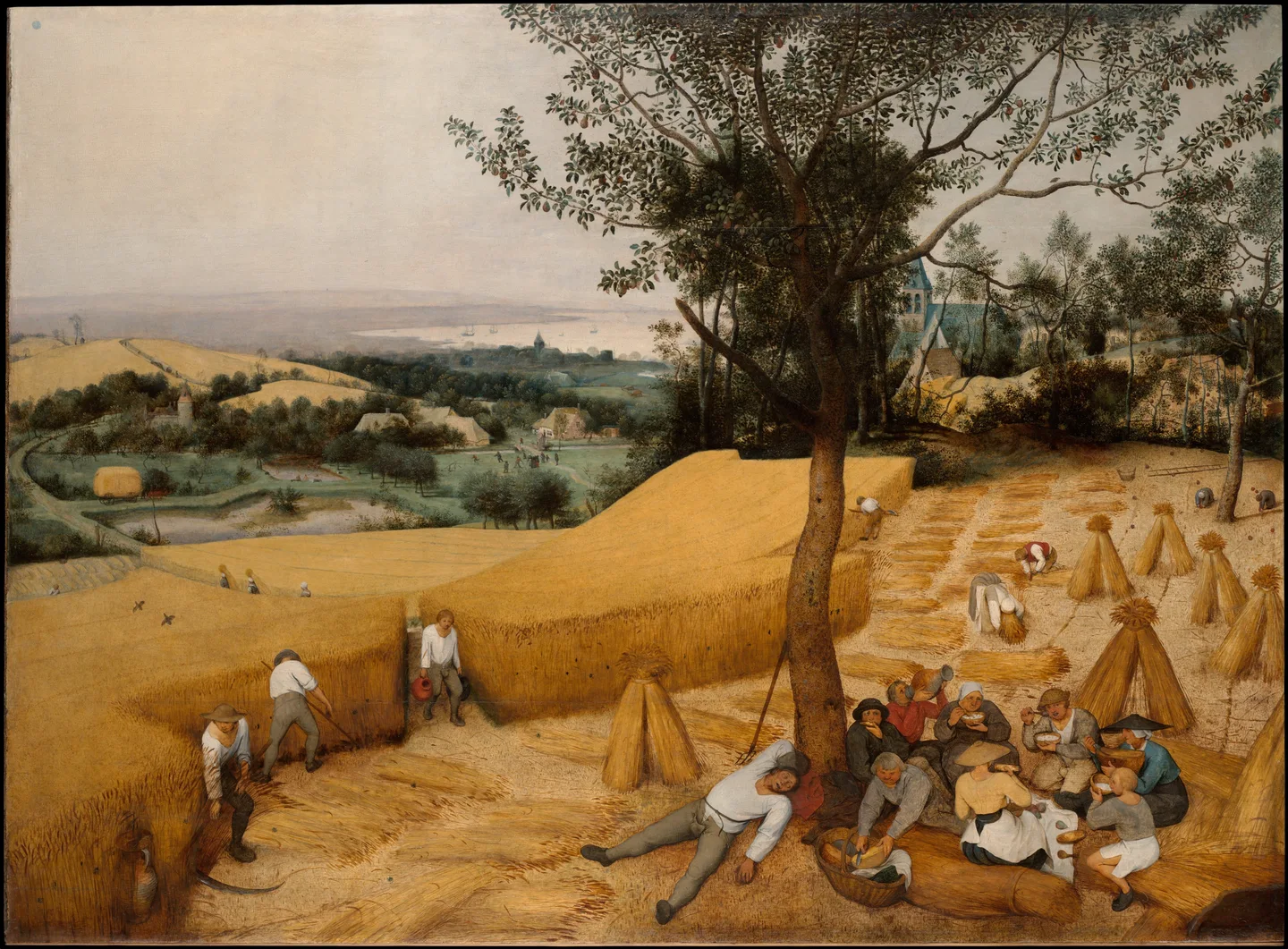
- In Bruegel's The Harvesters, are all the people below the tall tree doing the same kind of work? Name one visible action that distinguishes the meal break from the harvesting elsewhere in the field. Look for what the hands are doing.
- Which painter exhibited Impression, Sunrise in the first independent exhibition of the group later called the Impressionists? Pick from Claude Monet, Paul Gauguin, and Georges Seurat.
Questions six through ten
- Compare a reproduction of Van Gogh's Wheat Field with Cypresses with the title. Which part of the picture would still tell you the trees are cypresses if you covered the yellow field, the flame-shaped vertical silhouettes or the low rounded hills? Make a quick outline of the feature you remember, then compare it with the museum image in the answer key.
- Which technique builds an image by fitting together small pieces of stone or glass, fresco or mosaic? Imagine a close view of the surface under light coming from the side.
- Which work dates from 1937, Picasso's Guernica or Goya's The Third of May 1808? The date embedded in one title identifies the event depicted, so distinguish historical subject from date of production.
- In Grant Wood's American Gothic, which implement stands upright in front of the figures, a pitchfork, a rake, or a scythe? Picture how its shape relates to details on the man's clothing.
- Which group of works investigates changes of light on a repeated architectural facade, Monet's Rouen Cathedral paintings or Van Gogh's paintings of the postman Joseph Roulin? Identify the series and the element held relatively constant.
Answer key and evidence
- The Last Supper. Leonardo worked on the Milan wall painting during the 1490s. The Vatican Museums’ account of the ceiling records Michelangelo’s work between 1508 and 1512. Each work also belongs to a different architectural setting, a refectory and a chapel respectively.
- Katsushika Hokusai. The mountain is Mount Fuji. Its small, stable triangle provides a visual counterweight to the curling foreground wave. The Met’s impression identifies the series as Thirty-six Views of Mount Fuji.
- She pours a narrow stream into a vessel. The action occupies remarkably little of the total surface. The Rijksmuseum’s full view shows how her downward gaze and the tilt of the jug draw attention to it across the surrounding pale wall.
- Some are eating or resting. Several people gather beside the tree with food, while others farther into the golden field stand and work with tools or carry cut grain. Accept either eating or resting if you can locate the contrasting work in the field. Bruegel’s canvas shows more than one stage in a working day.
- Claude Monet. The Musée Marmottan Monet’s record identifies the harbor view and relates its title to the 1874 exhibition. The title helped supply the occasion for a critic's use of the term Impressionist. The guide to Impressionism explores what the exhibiting artists shared.
- The flame-shaped vertical silhouettes. In The Met’s June 1889 painting, the tall dark trees rise at the right, interrupting the long horizontal bands of field and distant ridge. The hills help establish the setting but do little to identify a tree species. You can therefore recover a distinctive term from the title even when much of the landscape is concealed.
- Mosaic. The pieces are called tesserae. Their separate surfaces can catch and reflect light at slightly different angles. In buon fresco, pigment is applied to damp plaster and becomes integrated with the surface as it sets.
- Guernica. The Reina Sofía’s record for the 1937 canvas explains how Picasso responded to the bombing of the Basque town during the Spanish Civil War. Goya painted The Third of May in 1814, looking back on executions following the Madrid uprising of 1808.
- A pitchfork. In the Art Institute’s American Gothic, its upright tines echo linear details elsewhere in the picture. A silhouette can carry enough information to identify a common tool even when the reproduction is too small for a face to be legible.
- Monet's Rouen Cathedral series. The facade anchors differences in illumination and atmosphere. Van Gogh's Roulin portraits offer another kind of repetition, a recognizable sitter returning with changes in pose, color, and background.
Put the score to work
Circle any correct answer supported by a guess. Place it next to a missed question that used the same kind of evidence. For chronology, try Which Came First and rehearse the relative order aloud after each reveal. For a second set organized around cultural exchanges, try the history of art revision quiz. More exercises belong to the time and memory collection.
Frequently asked questions
Should I give myself half a point for knowing the mountain but missing the designer?
Use the designer for the stated score, and record Fuji separately as a useful association. On a later attempt, start with the mountain and see whether it now brings Hokusai's name to mind.
How should I review dates when I keep mixing up two works?
Attach each date to a different physical setting or historical event. Then practice the pair in both directions, identifying the earlier work and identifying what was happening when the later one was made.
Review a missed date
Write each missed pair in chronological order and add the clue that places the earlier work. For the next pair, say your reason aloud before revealing the dates.
Play Which Came First?