Most Famous Paintings in the World
The most famous paintings in the world: a ranked guide to iconic works, with context and close-looking tips.
Which are the most famous paintings in the world? No single survey measures recognition across every country and generation. This editorial ranking chooses ten paintings with long histories of reproduction and public recognition, then asks what survives when each image travels. It complements the general guide to famous paintings with a shorter, ranked route through unusually recognizable compositions. The order reflects a judgment about circulation and visual distinctiveness. Auction price, current popularity, and artistic quality would each produce different lists.
Ranks one to three survive a tiny crop
How these ten were chosen. These are editorial choices based on the circulation of reproductions and how much of a composition can still be recognized in a crop. A classroom, museum shop, and family photo album would each yield a different order.
- Leonardo da Vinci, Mona Lisa. The most portable detail may be the least definite, the small area where cheek and mouth meet. The whole portrait relies equally on a steady arrangement of hands and a landscape that opens on either side of the sitter. Compare a tiny reproduction of her head with the full panel. An icon of a smile becomes a much more complicated encounter between a seated figure and the person facing her.
- Vincent van Gogh, The Starry Night. A dark cypress reaches upward from the left and connects a village to an intensely active sky. The relation between a stable steeple and that restless movement survives on a postcard. The scale and direction of the individual painted marks take longer to recover. Trace one sweeping band with your eye and notice where shorter strokes pull away from it.
- Michelangelo, The Creation of Adam. A narrow gap between two index fingers has become an image in its own right. On the Sistine ceiling, an entire reclining body and an approaching group help create the pull across that gap. The cropped fingers identify the picture, but the full composition explains why the hands seem to carry such different reserves of energy.
Ranks four through six turn a setting into a story
- Leonardo da Vinci, The Last Supper. Christ occupies the middle of a long table as groups of apostles respond to an announcement. Their reactions extend across the room in gestures rather than a sequence of separate episodes. The painted space also addresses the actual refectory wall in Milan. In a distant view of the room, look for the point where real architecture hands the eye over to the imagined dining chamber.
- Pablo Picasso, Guernica. A bull, a wounded horse, and people in anguish occupy a long, shallow space. Black and white give the scene the graphic clarity of an image that could travel in the press. Its immense scale creates a different experience in the gallery. Name one shape that helps organize the picture before trying to assign every figure a single symbolic meaning.
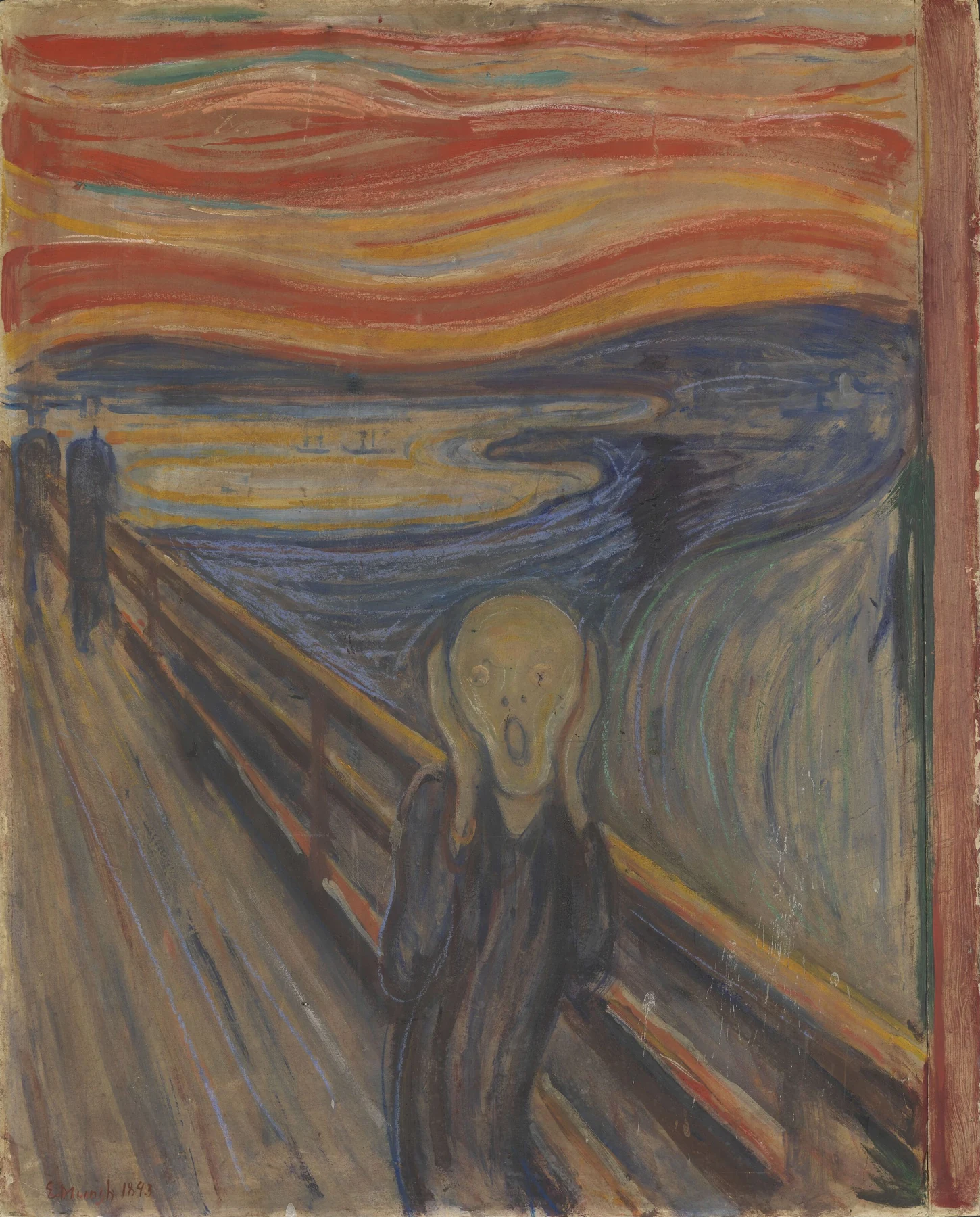
- Edvard Munch, The Scream. A figure presses hands against its head on a path above water. Two other figures continue in the distance, while sky and land seem to bend around the foreground head. Munch revisited the motif in several versions and made a lithograph. A particular version's material and dimensions matter when comparing the well-known shorthand image with an actual object.
Ranks seven through ten reward a full-width view
- Sandro Botticelli, The Birth of Venus. The standing goddess on her shell is instantly recognizable, yet the movement comes from the sides. Winds on the left blow toward the shore, while a figure on the right prepares to receive Venus. Follow one strand of hair or fabric across the image and the motion becomes clearer.
- Johannes Vermeer, Girl with a Pearl Earring. A turned head, open mouth, and glint at the ear carry the picture with very little setting. The head covering provides a large sweep of color above a face modeled more gradually. Identify where the supposed pearl is actually outlined and where its form relies on reflected light against shadow.
- Grant Wood, American Gothic. A house, a pitchfork, and two upright figures establish a pattern of vertical forms. The picture has supported countless rearrangements because that pattern is so easy to reconstruct. Locate the pointed upper window that helps explain the title before deciding what relationship the figures represent.
- Frida Kahlo, The Two Fridas. Two seated bodies share a bench, a face, and a linking vessel. Clothing divides the figures into visibly different presentations of the same person. Their joined hands hold the composition together. Seen at its actual scale, the double portrait offers a viewer two nearly life-size presences under one sky.
Build your own ranking from a different audience
Give a group five minutes to name paintings from memory. Have each participant describe the identifying detail before anyone supplies a title. Compare the results with the index of one hundred paintings and test your recall in Name That Painting. A classroom, a gallery, and a family across several generations may produce quite different results. The painter identification quiz separates recognition of a picture from recognition of the artist's name.
Frequently asked questions
Why are so many museum images left out?
A list of ten favors pictures with a particular kind of public circulation. Schools, publishers, reproductions, tourism, and languages all influence which works reach a given audience. The wider famous paintings collection makes room for individual traditions, formats, and artists excluded by a short ranking.
Do several versions of one composition count as one painting?
Here The Scream appears as a recognizable motif with several physical versions. If you make an object checklist for a museum visit, identify the particular version by medium, date, and collection. Those facts will also help explain differences in color or surface among reproductions.
Change the audience
Give three people the same small crops. Where does their order of recognition differ from yours, and which missing detail would you restore first?